Which Calorie Deficit to Choose for Women After 35
After 35, losing weight often feels different. What used to work effortlessly stops producing results. Weight comes off more slowly, fatigue is felt more strongly, and plateaus occur.
The main mistake during this period is choosing too strict a calorie deficit. Let's discuss which deficit suits women after 35 and why moderation brings better results.
Why Weight Stalls on a Calorie Deficit: Main Causes and What to Do
This situation is familiar to many: the calories are counted, there is a deficit, but the weight stays the same. For a day, a week, sometimes even a month. It feels like the body is "broken" or the formulas just don't work.
In practice, in 90 percent of cases, the problem is not metabolism, but specific factors that can be identified and corrected. Let's sort out why weight can stall even with a calorie deficit and how to get things moving downward again.
Calorie Deficit: Which One to Choose and Why Too Little Often Gets in the Way
A calorie deficit is the foundation of weight loss. Without it, weight does not go down, but this is also where most mistakes are made. Some set the deficit too low and see no results, while others cut calories too much and face plateaus, breakdowns, and a decline in well-being.
Let's break down which calorie deficit to choose, why too low a calorie intake often hinders weight loss, and how to find a functional balance.
How to Count Calories Correctly: Scales, Portions, Oil, Drinks
Calorie counting works only under one condition: if you count them truly correctly. In practice, most people "are in a deficit" but the weight doesn’t go down precisely because of accounting errors. Oil, drinks, snacks, and inaccurate portions easily bring the deficit to zero.
In this article, we’ll look at how to count calories properly, what you absolutely must pay attention to, and how to simplify the process so it doesn’t turn into constant stress.
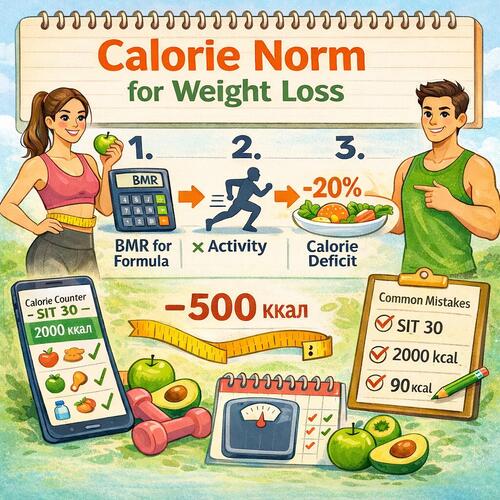
Calorie Norm for Weight Loss: How to Calculate (Formula, Example, Common Mistakes)
The right calorie norm for weight loss doesn't start with guessing and not with "1200 for everyone," but with calculating your daily needs and setting a reasonable deficit. The most practical option for most people in everyday life:
calculate your basal metabolic rate (BMR) using the Mifflin-St Jeor formula
multiply by the activity factor to get your maintenance (TDEE)
make a 10-20% deficit and monitor the trend for 2-3 weeks
Counting calories has long become one of the most popular ways to control weight and achieve health and fitness goals. However, many people who are just starting out on this journey find that counting calories can seem too complicated or tedious. In this article, you will find simple and clear tips to make the process as comfortable and effective as possible. In addition, we will tell you how to take advantage of the SYPB 30 calorie counter to simplify the calculation and analysis of your diet.
Hidden Sugar: 10 Foods You Didn’t Expect to Find It In How to Detect “Sweet Enemies” in Your Diet and Reduce Sugar Intake
Excessive sugar consumption is one of the main problems of modern nutrition. We’re all aware of the dangers of sweets, but we can hardly ever keep track of and count the “white crystals” in our diet. It’s especially hard to recognize so-called “hidden sugar”, which masquerades in the most unexpected foods. In this article, we’ll look at why this matters for your health, and which 10 foods may contain extra sweeteners—even if you don’t suspect it.
Healthy Eating or Diet: How to Understand What You Really Need?
Today, in an era of rapid changes, fashion trends, and endless lifehacks, special attention is paid to nutrition and a healthy lifestyle. But how do you figure out what suits you best—a short-term diet or a long-term switch to Healthy Eating (a healthy lifestyle)? In this article, we will analyze in detail the key differences, the advantages of each approach, and how to make a conscious choice.
Many people striving to lose weight are focused on diets and physical activity. However, one of the key factors affecting successful weight loss often goes overlooked — this is quality and restful sleep. Sleep plays a critical role in regulating hormones responsible for appetite and satiety, such as leptin and ghrelin. In this article, we will look at how lack of sleep affects these hormones and share tips on normalizing your sleep routine for effective weight loss.
We have all heard the universal advice: “Drink more water.” But why is hydration so important? Water is the basis of life and one of the main components of our body, making up about 60% of an adult’s body mass. It is involved in numerous processes required to maintain health and the normal functioning of organs. However, many of us often forget the importance of a proper drinking regimen. In this article, we will discuss how much water you should drink, why it is necessary, and how to know if your body lacks fluids.
 Which Calorie Deficit to Choose for Women After 35
 Why Weight Stalls on a Calorie Deficit: Main Causes and What to Do
 Calorie Deficit: Which One to Choose and Why Too Little Often Gets in the Way
 How to Count Calories Correctly: Scales, Portions, Oil, Drinks
 Calorie Norm for Weight Loss: How to Calculate (Formula, Example, Common Mistakes)
 Counting calories has long become one of the most popular ways to control weight and achieve health and fitness goals. However, many people who are just starting out on this journey find that counting calories can seem too complicated or tedious. In this article, you will find simple and clear tips to make the process as comfortable and effective as possible. In addition, we will tell you how to take advantage of the
  Hidden Sugar: 10 Foods You Didn’t Expect to Find It In
 Healthy Eating or Diet: How to Understand What You Really Need?
 Many people striving to lose weight are focused on diets and physical activity. However, one of the key factors affecting successful weight loss often goes overlooked — this is quality and restful sleep. Sleep plays a critical role in regulating hormones responsible for appetite and satiety, such as leptin and ghrelin. In this article, we will look at how lack of sleep affects these hormones and share tips on normalizing your sleep routine for effective weight loss.
 We have all heard the universal advice: “Drink more water.” But why is hydration so important? Water is the basis of life and one of the main components of our body, making up about 60% of an adult’s body mass. It is involved in numerous processes required to maintain health and the normal functioning of organs. However, many of us often forget the importance of a proper drinking regimen. In this article, we will discuss how much water you should drink, why it is necessary, and how to know if your body lacks fluids.