

Buckwheat or pasta for weight loss: which is more calorie-dense and which is better
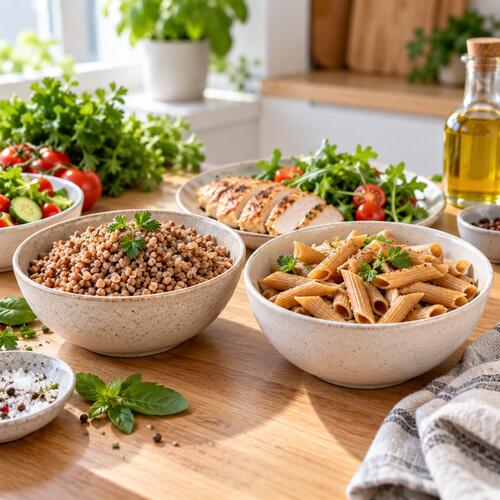 Buckwheat or Pasta for Weight Loss: Which is More Caloric and Which is Better
Buckwheat is considered an almost essential product for weight loss, while pasta is often habitually avoided. But is buckwheat really significantly lower in calories? Can you eat pasta when losing weight? And what should you choose as a side dish if you're counting calories?
Short answer: you can lose weight with both buckwheat and pasta. In their dry form, their caloric value is quite similar. After cooking, the numbers per 100g change due to the amount of water absorbed. Therefore, the name of the side dish is less important than the portion size, the cooking method, and the total caloric value of your diet.
Let’s break it down in detail.
Which is More Caloric: Buckwheat or Pasta
If you compare dry products, there is not much difference.
Approximate values per 100g of dry product:
| Product | Calories |
|---|---|
| Buckwheat groats | about 330-350 kcal |
| Pasta | about 340-370 kcal |
The exact values depend on the manufacturer and product composition, so when counting calories, it’s better to check the information on your specific packaging.
It turns out that dry pasta is usually a little more caloric than buckwheat, but the difference is minor.
The comparison looks very different after cooking.
Why Boiled Buckwheat and Pasta Become Less Caloric per 100g
During boiling, both buckwheat and pasta absorb water.
Water contains no calories but increases the weight of the finished food.
For example, you started with 100g of dry product. After cooking, it may weigh 220, 250, or even 300g.
The amount of energy does not increase because of the water itself. Instead, the same calories are distributed over a larger amount of the final dish.
This is why the number of calories per 100g of cooked product is significantly lower.
Approximately:
| Cooked product without oil or sauce | Calories per 100g |
|---|---|
| Boiled buckwheat | about 90-120 kcal |
| Boiled pasta | about 120-160 kcal |
These are approximate values. They mainly depend on how much water the product absorbed.
This is why you cannot compare a package of dry buckwheat with a table of calories for boiled pasta.
If you're confused about which weight to use for grains and pasta, check how to count calories in raw or cooked form.
Why 100g of Dry and 100g of Cooked Pasta Are Not the Same
This is one of the most common mistakes when counting calories.
Imagine your package of pasta says 350 kcal per 100g.
You cook 100g of dry pasta and end up with, say, 240g of cooked pasta.
The entire pot still contains about 350 kcal, as long as you haven't added other ingredients.
But now:
350 ÷ 240 × 100 = about 146 kcal per 100g of cooked pasta.
If someone eats all 240g, they will get the same approximate 350 kcal.
So, pasta doesn’t become half as caloric after boiling. Only the calories per 100g change due to water.
The same happens with buckwheat.
Buckwheat or Pasta for Weight Loss
If your goal is specifically weight loss, neither side dish has a decisive advantage over the other.
Weight loss occurs when, on average, a person consumes less energy from food than they expend.
You can eat buckwheat every day and not lose weight if your total diet is too caloric.
Conversely, you can eat pasta regularly and still lose weight if you maintain a reasonable calorie deficit.
So, the question is better asked this way:
«Which is allowed for weight loss, buckwheat or pasta?»
Instead, ask:
«What portion of this product can I include in my diet?»
Why is Buckwheat So Often Recommended for Weight Loss
Buckwheat does have several convenient qualities.
It requires almost no complicated preparation, goes well with meat, fish, eggs, and vegetables, and the portion is easy to control.
Additionally, buckwheat contains dietary fiber and provides a fairly hearty side dish.
But that doesn’t mean it has any special fat-burning properties.
If you add a lot of butter, fatty sauce, and high-calorie meat to a large portion of buckwheat, the dish can end up significantly more caloric than a regular portion of pasta with veggies and chicken.
Is It Possible to Eat Pasta When Trying to Lose Weight
Yes.
The mere fact of including pasta in your diet does not prevent weight loss.
Much more important are:
-
Portion size.
-
Total caloric value of the dish.
-
Amount of oil and sauce.
-
Other foods eaten throughout the day.
-
Pasta composition.
If you like pasta, there’s no need to exclude it just because you want to lose weight.
Banning your favorite foods can sometimes make the diet harder to stick to over time.
Which Pasta is Best to Choose
The simplest option: check the ingredient list.
High-quality regular pasta usually has a short list of ingredients.
If you'd like to increase your fiber intake, you can choose whole grain pasta.
But don't assume that the label «from durum wheat» makes a portion nearly non-caloric.
Such pasta still contains calories.
The difference is mainly in the composition and properties of the product, not in its caloric value disappearing.
Whole Grain Pasta or Buckwheat
This comparison becomes even more interesting.
Whole grain pasta generally contains more fiber than regular pasta made from refined flour.
Therefore, the statement «buckwheat is always healthier than any pasta» is too simplistic.
Both products can be part of a normal balanced diet.
You can choose based on:
-
taste;
-
digestive tolerance;
-
the specific product’s composition;
-
amount of fiber in the rest of your diet;
-
what you plan to eat as a side dish with it.
You don’t have to choose the same carbohydrate source every day.
Which is More Filling: Buckwheat or Pasta
Satiety doesn’t depend solely on the side dish.
The entire meal plays a big role.
For example, 150g of plain buckwheat may satisfy hunger less than 150g of pasta with chicken breast, vegetables, and salad.
And the reverse can be true as well.
To make your meal more filling, it’s helpful to pair your side dish with a source of protein and vegetables.
For example:
-
buckwheat + chicken + vegetables;
-
pasta + fish + vegetables;
-
buckwheat + egg + salad;
-
pasta + turkey + vegetable sauce.
Satiety depends on more than just the side dish. Also see how much protein you need for weight loss and how to distribute it throughout the day.
You can find ready-made combinations of side dishes, protein, and veggies in the collection 15 filling lunches for weight loss at 300, 400, and 500 kcal.
What is Better After a Workout
Both buckwheat and pasta can be used as a source of carbohydrates after exercising.
There's no need to eat only buckwheat.
If your diet includes enough protein and the overall calorie content matches your goal, regular pasta can also be included after physical activity.
For example:
-
pasta + chicken + vegetables;
-
buckwheat + fish + salad;
-
pasta + turkey + tomato sauce.
The main thing is for your total daily diet to meet your body's needs.
What is Better for Dinner: Buckwheat or Pasta
You can use both products.
The time of day in itself doesn’t turn pasta or buckwheat into fat.
For weight loss, the overall energy balance is much more important.
If it’s convenient for someone to have a small portion of pasta with protein and veggies in the evening, there’s no need to switch it for buckwheat just because of the time.
The same goes for buckwheat.
The problem more often is not the specific side dish, but the overall size of the evening portion and the additional foods added.
For example, 150g of plain pasta and a large plate of pasta with cream sauce, cheese, and oil have very different caloric values.
If your main difficulty is in the evenings, see what to eat in the evening to lose weight without hunger.
How Much Buckwheat Can You Eat When Losing Weight
There’s no universal portion size for everyone.
The amount depends on the total caloric value of your diet, body weight, activity, and your other meals.
For many people, a convenient starting point can be a portion of about 100-200g of cooked buckwheat.
But this is not a strict standard.
One person may need 100g, another 200g or more.
The main thing is to count exactly the amount you actually ate.
How Much Pasta Can You Eat When Losing Weight
The same principle applies.
A typical serving of cooked pasta might be about 100-200g, but there’s no single answer.
If you're counting calories, it's much easier to determine the amount of dry product before cooking.
For example, you took 60g of dry pasta.
If the label says 350 kcal per 100g:
350 × 60 ÷ 100 = 210 kcal.
After cooking, those 60g may turn into about 140-170g of cooked pasta, but the caloric value of the original portion will remain about the same.
What is More Likely to Hinder Weight Loss: Pasta or What You Add to It
Very often the issue is not pasta itself.
Let’s look at a typical plate:
-
pasta 200g;
-
cream sauce;
-
cheese;
-
a tablespoon of oil;
-
ground meat.
The side dish itself may make up only part of the calories in the meal.
Oil, cheese, and fatty sauce can significantly raise the total calorie count.
So someone might decide, «Pasta makes you fat,» even though a significant part of the calories came from the additions.
The same happens with buckwheat.
Buckwheat with butter, fried meat, and fatty gravy also stops being a relatively light meal.
It’s especially important to pay attention to oil. We have a separate article on how to count oil during frying, baking, and in salads.
Buckwheat with Oil or Oil-Free Pasta: Which is More Caloric
The result can be quite surprising here.
Vegetable and butter oils are very energy dense.
So a serving of buckwheat with a lot of oil can have more calories than an equal-weight portion of pasta without oil.
That’s why, when counting calories, it's important to account for more than just the main product.
It’s very easy to forget to count:
-
cooking oil;
-
butter;
-
cheese;
-
mayonnaise;
-
sauces;
-
cream;
-
nuts and seeds.
Sometimes it’s these products that explain the difference between the supposed and the real caloric value of a dish.
Which is Healthier: Buckwheat or Pasta
You can’t correctly classify products as absolutely healthy or unhealthy just by their name.
Buckwheat has its own set of nutrients.
Pasta made from wheat has a different composition.
Whole-grain pasta differs from regular.
In addition, a person doesn’t eat only one side dish.
For health, the diversity of the whole diet matters much more: vegetables, fruits, protein sources, whole grain products, sufficient fiber, and a reasonable amount of fats.
So, there’s no need to pick a single winner and eat only that food.
Can You Alternate Buckwheat and Pasta
Yes, and for most people, this is much more practical than eating only buckwheat every day.
For example:
-
Monday, buckwheat;
-
Tuesday, pasta;
-
Wednesday, rice;
-
Thursday, potatoes;
-
Friday, buckwheat again.
A varied diet is usually easier to stick to over a long time.
Weight loss shouldn't turn into an endless bowl of dry buckwheat and chicken breast.
Buckwheat or Pasta: A Comparison
| Parameter | Buckwheat | Pasta |
|---|---|---|
| Calories in dry form | about 330-350 kcal | about 340-370 kcal |
| Allowed with weight loss | Yes | Yes |
| Allowed in the evening | Yes | Yes |
| Suitable as side dish | Yes | Yes |
| Caloric value depends heavily on additions | Yes | Yes |
| Whole-grain options available | Not relevant | Yes |
| Must be excluded for weight loss | No | No |
The main difference for someone losing weight is usually not the 10-20 kcal between products, but portion size and what’s added to the plate.
How to Properly Count Calories for Buckwheat and Pasta
The most convenient way is:
-
Weigh the food dry.
-
Check the calories on the package.
-
Calculate the calories in your dry portion.
-
After cooking, divide the finished dish into the necessary number of portions.
For example, you boiled 200g of dry pasta.
The package says 350 kcal per 100g.
200g = 700 kcal.
After boiling, you have 500g of pasta.
So:
700 ÷ 500 × 100 = 140 kcal per 100g of cooked product.
Now you can weigh your ready portion.
The same principle applies for buckwheat.
If you’re just beginning to keep a food diary, check out the guide on how to properly count calories, portions, oil, and drinks.
What to Do if Your Weight Stops Dropping
Switching from pasta to buckwheat just because your weight isn’t dropping is usually not enough.
First, review your overall diet.
Weight can temporarily plateau due to water retention, digestion, workouts, and normal physiological fluctuations.
If there’s truly no change for an extended time, it’s helpful to check:
-
portion sizes;
-
oil;
-
drinks;
-
snacks;
-
sauces;
-
weekends;
-
calculation accuracy.
Very often, several small sources of calories are more important than the choice between buckwheat and pasta.
Frequently Asked Questions
Which is More Caloric: Buckwheat or Pasta?
In dry form, their calories are quite close. Pasta is often a little more caloric, but the difference is minor. After cooking, the values depend heavily on how much water is absorbed.
Can You Eat Pasta When Losing Weight?
Yes. If your portion fits your daily calorie target, pasta does not prevent weight loss.
Which is Better for Weight Loss: Buckwheat or Pasta?
Both products are suitable. The choice depends on your preferences, the composition of your diet, and portion size.
Is Durum Wheat Pasta Allowed for Weight Loss?
Yes. But this kind of pasta still contains calories, so the portion size matters.
Can You Eat Pasta in the Evening for Weight Loss?
Yes. The total caloric intake for the day is more important than banning a specific product after a certain hour.
Which is More Filling: Buckwheat or Pasta?
It depends on the portion and the entire meal. Adding protein and vegetables usually affects satiety more than simply switching the side dish.
How Much Cooked Pasta Can You Eat When Losing Weight?
There’s no single standard. Portions of about 100-200g of cooked product are often used, but the exact amount depends on your personal calorie needs.
How Much Buckwheat Can You Eat When Losing Weight?
There is also no universal norm. It’s more important to factor the portion into your total daily caloric balance.
Main Points
Buckwheat is not an essential food for weight loss, and pasta is not forbidden.
In terms of calories, dry products are quite similar.
After boiling, the per-100g values differ mainly due to the amount of water.
If you want to lose weight, it’s far more important to pay attention to:
-
portion size;
-
total caloric value of your diet;
-
amount of oil and sauces;
-
sufficient protein and vegetables;
-
the regularity of a diet you can maintain for a long time.
So you don’t have to choose between buckwheat and pasta forever.
Eat the side dish you enjoy, control the amount, and pay attention to your overall diet.
This approach is much more practical than a strict list of “allowed” and “forbidden” foods.
 Why You Shouldn’t Weigh Yourself After Eating and When It’s Okay to Step on the Scale
 How to Count Calories Without Scales: Product Measurements Table in Spoons, Cups, and Portions
 What Groceries to Buy for a Week of Weight Loss: Ready-to-Use Shopping List
 Which Yogurt to Choose: Read the Ingredients, Not the Marketing Labels
 Protein Snacks: 20 Options from Everyday Foods
 Does Fitness Help You Lose Weight: How Workouts Affect Weight and Body Shape
 Menu for 1600 kcal per day: ready meal plan with weights and nutritional breakdown
 Why You Can Overeat Even With Healthy Food
 How to Count Calories When Cooking for the Whole Family