

Counting Calories in Raw or Cooked Form: Calculation Rules
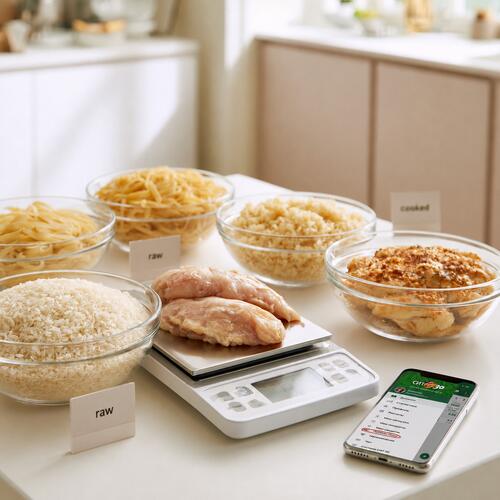 Count Calories Raw or Cooked: How to Weigh Foods Correctly
Buckwheat becomes heavier after boiling, while chicken breast, on the other hand, loses weight after baking. Water does not add calories to foods, and its evaporation does not turn ordinary fillets into higher-calorie food.
So how should you count calories: raw or cooked?
The main rule is very simple:
You should count the product in the state for which calorie content is indicated in the app database or on the packaging.
If you weighed dry groats, choose dry groats in the food diary. If you weighed ready-made porridge, find an entry marked as “boiled” or “cooked.”
You should not weigh 200 g of cooked buckwheat and apply the calorie content for 100 g of dry groats. This mistake can increase the calculation two- or threefold.
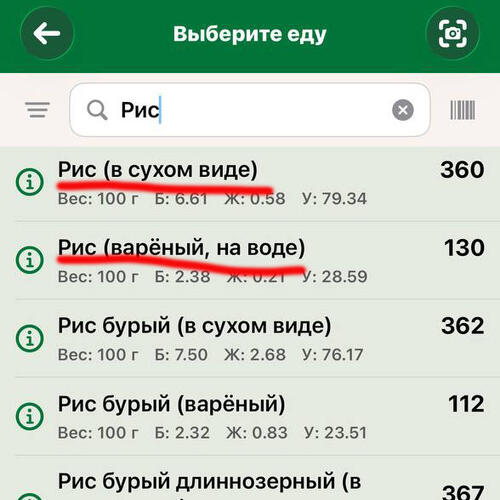 In the SIT30 calorie counter database, raw and cooked products are usually represented as separate entries. For example, you can find both dry rice and rice after cooking. This is necessary because after boiling, baking, or frying, the amount of water changes and, consequently, the calories per 100 g of product.
Quick Reference
Remember these four rules:
-
If you weighed the product raw, choose the calorie content for the raw product.
-
If you weighed it cooked, choose the calorie content for the cooked product.
-
If you use information from the package, check which state it refers to.
-
If you are making a dish from several ingredients, count it as a recipe and indicate the actual weight after cooking.
Raw or cooked alone is not absolutely right or wrong. Mistakes happen when the weight is taken for one state, but the calorie content chosen for another.
The formula is always:
Calories per serving = serving weight × calories per 100 g / 100
At the same time, both the weight and calories must refer to the same state of the product.
Why Raw and Cooked Foods Have Different Calories
During cooking, foods can:
-
absorb water;
-
lose water;
-
absorb oil;
-
lose some fat;
-
release juice or broth;
-
increase or decrease in weight.
The change in weight during cooking is mainly due to the loss or absorption of water, and in some foods also to the loss or addition of fat. These changes are taken into account when calculating the yield of cooked food.
For example, dry pasta absorbs water and becomes heavier. The total calories in the pot don’t change much when boiled, but the calories per 100 g of ready pasta become lower.
Meat loses water while baking. The finished piece weighs less, so in 100 g of cooked meat there are usually more calories than in 100 g of raw meat.
This doesn’t mean that meat suddenly becomes more calorific after baking. It’s just that the same nutrients are now in a smaller total weight.
Grains: Count Dry or Cooked
It’s most convenient to weigh grains before cooking.
On the packaging of buckwheat, rice, bulgur, or oat flakes, the calorie content is usually indicated for the dry product. Therefore, you can:
-
Weigh the required amount of dry grain.
-
Enter this weight into your food diary.
-
Select the entry “buckwheat dry,” “rice dry,” or the exact product from the packaging.
After cooking, the grain absorbs water and becomes heavier, but water does not contain calories.
Buckwheat Example
Suppose the calorie content of dry buckwheat is 340 kcal per 100 g.
You took 100 g of dry grain:
100 × 340 / 100 = 340 kcal
After boiling, you got 300 g of ready porridge. The total calorie content remains about 340 kcal if you didn’t add butter, milk, or other foods.
Calories per 100 g of cooked buckwheat from this pot:
340 / 300 × 100 = 113 kcal
If you ate 200 g:
200 × 113 / 100 = 226 kcal
A common mistake looks like this:
-
someone weighs 200 g of cooked buckwheat;
-
chooses the calorie content for dry buckwheat, 340 kcal;
-
gets 680 kcal.
In reality, in this example the portion contains about 226 kcal. The error is more than 450 kcal.
Can You Count Cooked Grains?
Yes. To do this, you need to find the cooked product in the database:
-
buckwheat boiled;
-
rice boiled;
-
oatmeal porridge with water;
-
bulgur cooked.
However, the amount of water in porridge depends on cooking time, proportions, and preparation method. So the calories in your porridge may differ from the average database value.
A more accurate option for home cooking:
-
Weigh the dry grain.
-
Calculate its total calorie content.
-
Weigh all the cooked porridge.
-
Calculate the calories per 100 g according to the real yield.
Pasta: Dry Weight or Weight After Boiling
The same rule applies to pasta as to grains.
The calories listed on the package most often apply to the dry product unless the manufacturer states otherwise. The nutritional value on the label applies to the specified weight or serving, so before entering a product into your diary, check the serving size and the manufacturer’s clarifications.
Pasta Calculation Example
Suppose the packaging says 350 kcal per 100 g.
You measured 80 g of dry pasta:
80 × 350 / 100 = 280 kcal
After boiling, you got 200 g of pasta.
Calories per 100 g of cooked product:
280 / 200 × 100 = 140 kcal
You ate 150 g:
150 × 140 / 100 = 210 kcal
If you enter 150 g of cooked pasta using the calories for dry pasta, the app will show 525 kcal instead of 210 kcal.
Sauce, cheese, butter, and vegetable oil are counted separately.
Meat and Poultry: Weigh Before or After Cooking
Meat can be counted both raw and cooked. The main thing is not to mix the two methods.
Option 1: Weigh Raw Meat
This is the most convenient option for home cooking.
Steps:
-
Weigh the raw meat without packaging.
-
Select the matching raw product in the database.
-
Add oil, marinade, sauce, and other ingredients separately.
For example, if you weighed 250 g of raw chicken breast, choose “chicken breast raw,” not “chicken breast baked.”
Option 2: Weigh Cooked Meat
This option is also acceptable. In this case, choose the entry corresponding to the preparation method:
-
chicken breast boiled;
-
chicken breast baked;
-
beef stewed;
-
turkey cooked;
-
pork fried.
You shouldn’t weigh cooked chicken and apply the calorie content of raw chicken.
Why Finished Meat Is Higher in Calories Per 100 g
During cooking, meat loses moisture. The higher the temperature and the longer the cooking time, the more noticeable the water loss. Some cuts also lose part of their fat along with the juice.
Let’s look at a simplified example.
The calorie content of raw fillet is 120 kcal per 100 g. You took 250 g:
250 × 120 / 100 = 300 kcal
After baking, 190 g remains.
If you do not consider possible fat loss and additional ingredients, the calories per 100 g of cooked fillet will be about:
300 / 190 × 100 = 158 kcal
The total calories of the piece did not increase. Only its weight decreased.
For fatty meat, the calculation may be less precise, because some rendered fat remains in the dish or pan. If you do not eat this fat, the actual calories in the cooked meat may be lower than calculated by raw weight.
How to Account for Fish
The same rules apply to fish:
-
log raw fish as raw;
-
log baked fish as baked;
-
log fried fish as fried;
-
add oil, batter, breading, and sauce separately.
Pay attention to the edible part. If the fish is cooked with bones, head, or lots of skin, don’t log the entire weight as net fillet weight.
When counting a whole fish you can:
-
Weigh the fish before cooking.
-
After eating, weigh the remaining bones and inedible parts.
-
Subtract the remains from the original weight.
-
Use the entry that matches the product and cooking method.
For regular tracking, it’s easier to buy fillets or to create your own recipe in advance.
Vegetables: Weigh Raw or Cooked?
Most fresh vegetables are convenient to weigh raw. Especially if you’re making a salad or adding vegetables to a complex dish.
Good examples:
-
tomatoes;
-
cucumbers;
-
cabbage;
-
carrots;
-
peppers;
-
zucchini;
-
eggplant;
-
broccoli;
-
cauliflower.
If vegetables are baked or stewed for a long time, they can lose a significant amount of water. Because of this, their calories per 100 g will increase.
Zucchini Example
You took 500 g of zucchini with 20 kcal per 100 g:
500 × 20 / 100 = 100 kcal
After baking, 300 g remain.
Calories per 100 g of baked zucchini:
100 / 300 × 100 = 33 kcal
The total calories in the zucchini hardly changed, but the ready product became lighter.
The main mistake with vegetables is not about water, but oil.
If you add 15 g of vegetable oil, that’s about 135 kcal. Even if some oil remains on the tray, you can't completely ignore it.
For an accurate calculation of baked or stewed vegetables, it’s better to create a separate recipe.
Potatoes: Raw, Boiled, or Baked
You must select potatoes in the same state as they were weighed.
This may be different entries:
-
potato raw;
-
potato boiled without oil;
-
potato baked;
-
potato fried;
-
mashed potatoes.
It’s especially important not to mix regular potatoes with mashed or fried potatoes. Mashed potatoes may contain milk and butter, and when frying, potatoes absorb vegetable oil.
If you make mashed potatoes yourself, it’s more accurate to create a recipe from potatoes, milk, butter, and other additions. How to do this in the SIT30 app is explained in detail in the article "How to Count Calories in a Complex Dish"
Frozen Foods: How to Count Calories Correctly
It’s best to track frozen foods using the packaging information.
Check the product name and notes next to the nutrition facts. The manufacturer might list data for the product in packaging or for the meal after cooking according to instructions.
Frozen Vegetables and Berries
If they are standard vegetables or berries with no additives, you can weigh them frozen and select the corresponding entry from the database.
For example:
-
broccoli frozen;
-
frozen vegetable mix;
-
frozen cherries without sugar;
-
frozen blueberries.
After defrosting, the product may release water. If you eat the berries together with this juice, use the full weight of the portion.
If liquid was drained, it’s best to record the actual amount eaten.
Frozen Fish and Seafood
Check if the product has an ice glaze. Use the product weight without packaging and follow manufacturer notes on net weight.
Do not log breaded fish as plain fillet. Breading, oil, cheese or cream sauces can significantly increase calories.
Dumplings, Filled Dumplings, and Other Ready Meals
Calories on the package usually refer to the frozen product. After boiling, dumplings may absorb water and become heavier.
The simplest way:
-
Weigh the frozen portion.
-
Record the weight using info from the package.
-
Add oil, sour cream, and sauces separately.
Don't weigh already boiled dumplings and apply the calorie content of the frozen product.
Foods That Absorb Water
Foods that significantly increase in weight after cooking include:
-
rice;
-
buckwheat;
-
pasta;
-
oat flakes;
-
bulgur;
-
lentils;
-
beans;
-
chickpeas;
-
chia seeds;
-
dried mushrooms.
When a product is cooked in plain water, its total calories stay nearly the same. Only the weight increases.
For example, 100 g of dry lentils can turn into about 230–300 g of ready product. The exact yield depends on variety, cooking time, and amount of water.
That’s why ready lentils from your pot may differ in calories per 100 g from the average database entry.
If the grain or porridge is cooked in milk, cream, or broth, these foods must be added to the calculation too.
Foods That Lose Water
When frying, baking, or stewing, the following foods often become lighter:
-
meat;
-
poultry;
-
fish;
-
mushrooms;
-
zucchini;
-
eggplants;
-
tomatoes;
-
potatoes;
-
other baked vegetables.
After losing water, the food becomes more calorific per 100 g, but this does not mean there are more total calories.
For example, 500 g of mushrooms may weigh 250 g after frying. If no oil is added, the total calories in the mushrooms stay about the same, but 100 g of cooked mushrooms will have nearly twice the calories of 100 g of raw.
When adding oil, the total calories do actually increase, so oil must be counted separately.
What If the Calorie Information on the Package Is Unclear?
First, look carefully at the whole package, not just the main nutrition table.
Look for phrases like:
-
per 100 g of product;
-
per serving;
-
as prepared;
-
after preparation;
-
cooked product;
-
product prepared according to instructions.
If there are no extra notes, the data usually refer to the product as sold. However, for ready meals and dry mixes the manufacturer may also show the nutrition of the prepared dish.
Don’t use the cooked product data if you added a different amount of water, milk, oil, or other ingredients than indicated in the instructions.
How to Count Calories in a Complex Dish
For soup, pilaf, casserole, stew, or salad, it’s not enough to select a similar entry from the database. Even dishes with the same name can differ greatly in composition.
The accurate steps look like this:
-
Weigh every ingredient.
-
Select the calorie content for each one in its corresponding state.
-
Add oils, sauces, cheese, cream, and other extras.
-
Calculate the total calories of all ingredients.
-
After cooking, weigh the entire finished dish.
-
Calculate calories per 100 g.
-
Weigh each portion eaten.
Formula:
Calories per 100 g of dish = total calories of ingredients / final weight of dish × 100
Example Calculation: Rice and Chicken Dish
Suppose you used:
-
rice dry, 100 g: 350 kcal;
-
chicken fillet raw, 300 g: 360 kcal;
-
vegetables, 300 g: 90 kcal;
-
vegetable oil, 10 g: 90 kcal.
Total calories:
350 + 360 + 90 + 90 = 890 kcal
After cooking, the dish weighs 900 g.
Calories per 100 g:
890 / 900 × 100 = 99 kcal
Serving of 350 g:
350 × 99 / 100 = 347 kcal
In this case, you do not need to look for “rice boiled” and “chicken ready” in the database separately. All ingredients were considered before cooking, and the weight change from water is reflected in the final dish yield. How to do this in the SIT30 app is explained in detail in the article "How to Count Calories in a Complex Dish"
Common Mistakes in Food Diaries
Mistake 1: Cooked Grain Logged as Dry
The person eats 200 g of boiled buckwheat and selects “buckwheat dry.” The count is overestimated several times.
Mistake 2: Raw Meat Logged as Cooked
300 g of raw fillet are entered in the diary, but “baked chicken” is selected for calories. Due to the difference in water content, the final calories are overestimated.
Mistake 3: Oil Not Counted
Vegetables or meat are logged as plain products, even though 10–20 g of oil were used for frying.
Even a small amount of oil can noticeably change the calories in a dish.
Mistake 4: Calories Taken from a Random Entry
The first similar product in the database is selected without checking:
-
whether it is raw or cooked;
-
its fat percentage;
-
whether it contains skin;
-
whether oil or sauce has been added;
-
whether it matches the exact packaging.
Mistake 5: Weight and Calories Refer to Different States
For example, cooked pasta weighed after boiling, but the calories recorded from dry pasta packaging.
Mistake 6: Frozen Ready Meals Logged as Regular Product
Breaded fish is logged as plain fillet, and a vegetable mix with cream sauce as just vegetables.
Mistake 7: Dish Portions Estimated by Eye
Today a portion of pilaf weighs 250 g, tomorrow 400 g, but both are logged as “one portion.”
It's more accurate to weigh the cooked dish and each portion in grams.
Which Method to Choose for Daily Counting
For most home-cooked dishes, it’s convenient to stick to this scheme:
-
weigh grains and pasta dry;
-
weigh meat and fish raw;
-
weigh fresh vegetables raw;
-
count oil and sauces separately;
-
save complex dishes as recipes;
-
always weigh the finished dish to calculate calories per 100 g.
But this is not a mandatory requirement. You can track foods in the cooked state, as long as you select the corresponding entry in the database.
The timing of the weighing is less important than consistency. If today you log chicken breast by raw weight, and tomorrow by cooked, make sure you choose the right calorie content each time.
The Main Thing to Remember
There’s no single answer for all foods as to whether to count calories raw or cooked.
The correct principle is this:
Weigh the product in the state convenient for you and select the calorie content specifically for that state.
Dry grain is counted by dry weight. Cooked grain is counted by cooked weight. Raw meat is logged as raw, and cooked as cooked.
For dishes with multiple ingredients, the most accurate method is to calculate the total calories in the recipe and weigh the finished dish.
This way you account for water, weight changes, and the size of each portion, without guessing how many calories are in your plate.
Frequently Asked Questions
Should I weigh grains before or after boiling?
You can use both methods. If the grain is weighed dry, use the calories for dry grain. If weighed after boiling, use the calorie content for cooked porridge or calculate it according to the actual yield.
Is it better to weigh meat raw or cooked?
For home cooking, it’s usually more convenient to weigh meat raw and select the corresponding entry in the database. Cooked meat can also be counted, but its weight must match the calorie content of the cooked product.
Does the calorie content change after cooking?
The total calories of a product boiled in water usually change insignificantly, but the weight and calories per 100 g do change. When frying, adding oil or losing fat, total calories can also change.
How to count frozen products?
Use the information from the packaging. If calories are given for the frozen product, weigh it before cooking. If the manufacturer provides nutrition for the finished dish, follow the package instructions.
Can you weigh cooked porridge and choose dry grain?
No. You can’t multiply the weight of cooked porridge by the calories for dry grain. You need to select cooked porridge or calculate calories per 100 g based on the dry grain weight and final weight after boiling.
How to count calories in soup, pilaf, or casserole?
Add up the calories in all ingredients, weigh the finished dish and divide the total calories by its final weight. Then calculate calories per 100 g and weigh each portion.
See Also
-
How to Count Calories Correctly: Scales, Portions, Oil, and Drinks
- How to Count Calories in a Complex Dish
-
How to Count Calories Properly and Not Go Crazy: A Guide for Beginners
-
Why Weight Stalls on a Calorie Deficit: 12 Real Reasons and What to Do