

How to count calories in a complex dish: soup, pilaf, salad, and casserole
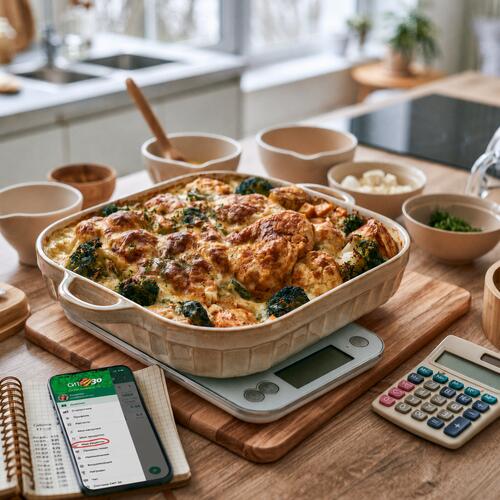 How to Count Calories in a Complex Dish: Soup, Pilaf, Salad, and Casserole
Calculating the calorie content of an apple or a pack of cottage cheese is easy: just check the nutrition label and indicate the weight you ate. The questions begin when meat, grains, vegetables, oil, sauce, and water are all combined in one pot.
How do you count the calories in a complex dish when ingredients change weight during cooking? What about the water in soup? How can you determine the calories in a single plate of pilaf or a piece of casserole?
There is one universal method for any homemade dish:
-
Weigh all the ingredients.
-
Calculate their total kcal content.
-
Cook the dish.
-
Weigh the finished dish.
-
Calculate the calories per 100 g.
-
Weigh only your own portion.
A recipe calculated once can be saved in SIT30. Moreover, the calorie counter will independently calculate the kcal content of complex dishes! After this, there's no need to add up the calories of potatoes, meat, oil, and other ingredients every day. Just select a saved recipe and enter the portion weight.
The Main Formula for Calculating a Complex Dish
First, you need to determine the calorie content of each ingredient:
Ingredient calories = product weight in grams × kcal per 100 g ÷ 100
Then add up the values obtained:
Total calories of the dish = sum of the calories of all ingredients
After cooking, weigh the entire finished dish and use the second formula:
Calories per 100 g = total dish calories ÷ weight of finished dish × 100
For calculating a specific portion:
Portion calories = calories per 100 g × portion weight ÷ 100
For example, if the whole pot contains 1800 kcal, and the finished dish weighs 2400 g:
1800 ÷ 2400 × 100 = 75 kcal per 100 g.
A portion weighing 350 g will contain:
75 × 350 ÷ 100 = 262.5 kcal.
What You Will Need for Accurate Calculation
For home calculations, a regular kitchen scale and the SIT30 app are enough.
Before cooking, it is best to write down the weight of an empty pot, baking dish, or other cookware. After cooking, you can weigh the dish together with the container and subtract the container's weight.
For example:
-
pot with finished soup weighs 4700 g;
-
empty pot weighs 1200 g;
-
the finished soup weighs 3500 g.
Don't put very hot cookware directly on regular scales. You can use a stable stand or transfer the dish to a pre-weighed container.
Which Ingredients to Weigh Before Cooking
Most ingredients are more conveniently counted in their raw state:
-
dry grains;
-
raw meat and fish;
-
fresh vegetables;
-
raw eggs without shells;
-
oil;
-
cheese;
-
milk, cream, and sour cream;
-
sauces;
-
flour;
-
sugar;
-
nuts and seeds.
The main rule: the state of the product in the app should match the state of the product on the scales.
If you have weighed 100 g of dry rice, select dry rice in the database. You don't need to add boiled rice to the recipe after cooking. Otherwise, the calories from the same grain will be counted twice.
If using an already prepared product, for example 200 g of boiled chicken, select the variant with the calories of cooked chicken.
Why You Should Weigh the Finished Dish
During cooking, ingredients change weight.
Grains and pasta absorb water and become heavier. Meat, vegetables, and casseroles lose moisture and become lighter. At the same time, water does not add any calories.
Because of this, the same total number of calories can be distributed over different weights of the finished dish.
Suppose a casserole contains 2000 kcal.
If after cooking it weighs 2000 g, there will be 100 kcal per 100 g.
If the casserole spent longer in the oven and its weight reduced to 1600 g, there will already be 125 kcal per 100 g.
The total calorie amount remains the same. Only the concentration of calories per 100 g changes.
Step-by-Step Example: Calculating the Calories of a Casserole
Let's calculate a chicken casserole with potatoes, zucchini, and cheese. Below is a step-by-step calculation in the SIT30 app in 5 steps.
Calorie amounts in the example are for illustration only. For real calculations, use the package information or specific product data in SIT30.
| Ingredient | Weight | Kcal per 100 g | Calories |
|---|---|---|---|
| Chicken breast | 500 g | 113 kcal | 565 kcal |
| Potato | 600 g | 77 kcal | 462 kcal |
| Zucchini | 400 g | 17 kcal | 68 kcal |
| Onion | 150 g | 41 kcal | 60 kcal |
| Eggs without shell | 110 g | 157 kcal | 157.3 kcal |
| Sour cream 15% | 150 g | 160 kcal | 240 kcal |
| Cheese | 100 g | 353 kcal | 353 kcal |
| Vegetable oil | 10 g | 899 kcal | 89.9 kcal |
Step 1. Calculate the Total Calories
Add up the calories of all the ingredients:
565 + 462 + 68 + 60 + 157.3 + 240 + 353 + 89.9 = 1995.2
The whole casserole contains approximately 1995.2 kcal.
Step 2. Weigh the Finished Casserole
After cooking, the casserole weighs 1600 g.
There's no need to divide the calories by the initial ingredient weight. Some water has evaporated, so for the calculation only the actual weight of the cooked casserole is used.
Step 3. Calculate Calories per 100 g
1995.2 ÷ 1600 × 100 = 124.7 kcal.
Round up:
The casserole contains approximately 125 kcal per 100 g.
Step 4. Calculate the Portion
A portion weighs 300 g:
124.7 × 300 ÷ 100 = 375 kcal.
A portion of casserole weighing 300 g will contain about 375 kcal.
Now there's no need to cut the casserole into perfectly even pieces. You can put any piece on a plate, weigh it, and enter the weight in SIT30.
How to Add a Complex Dish in SIT30
To avoid recalculating a homemade dish every time you eat it, save it as your own recipe.
Step-by-Step Instructions
-
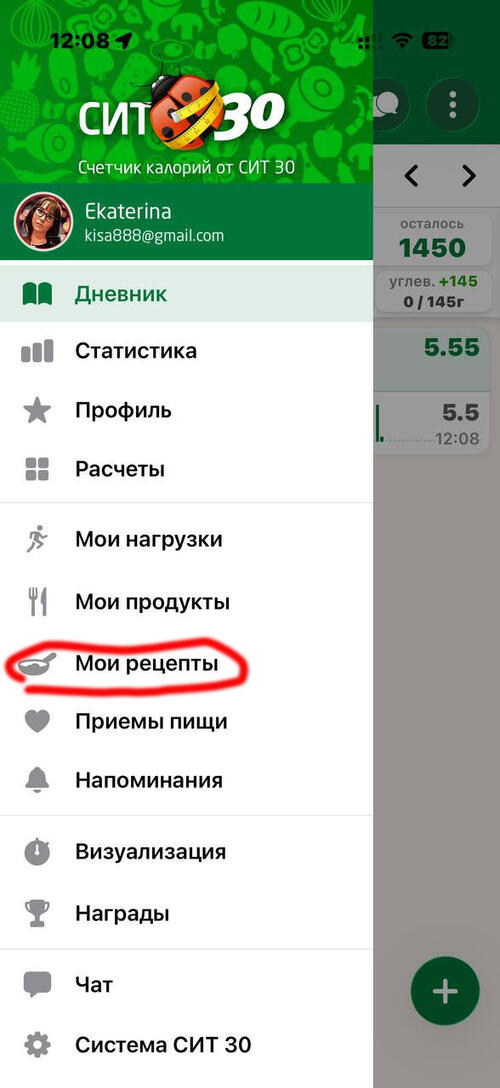
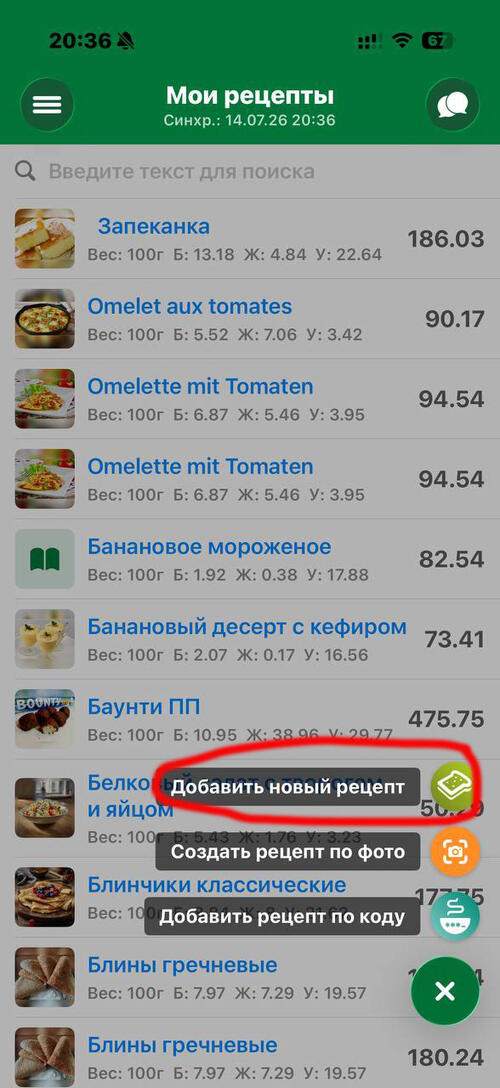
Open the side menu of the SIT30 app and go to the «My Recipes» section. Click the «+» icon in the bottom right corner and select «Add New Recipe».
-
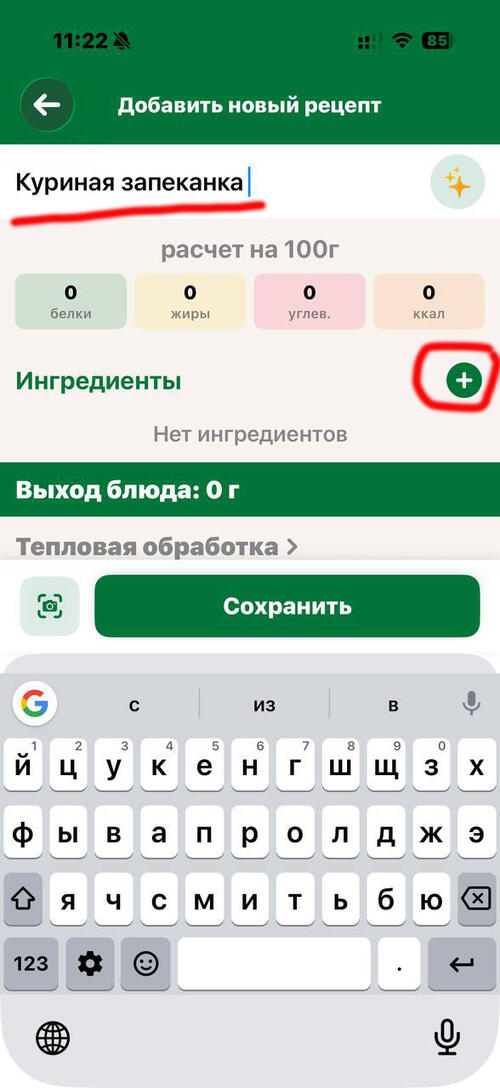
Enter a clear name for the dish, for example «Chicken Casserole». Then click the green «+» icon to the right of the «Ingredients» label.
-
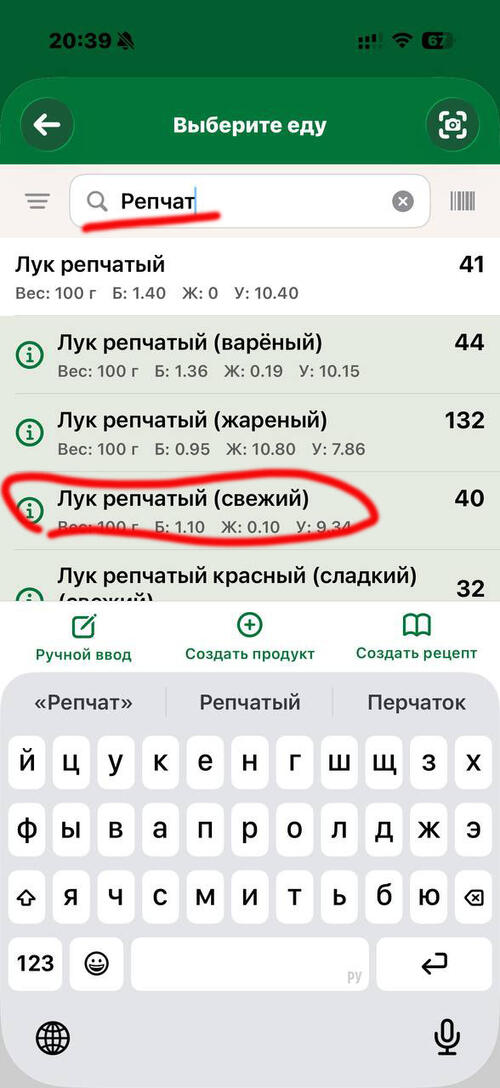
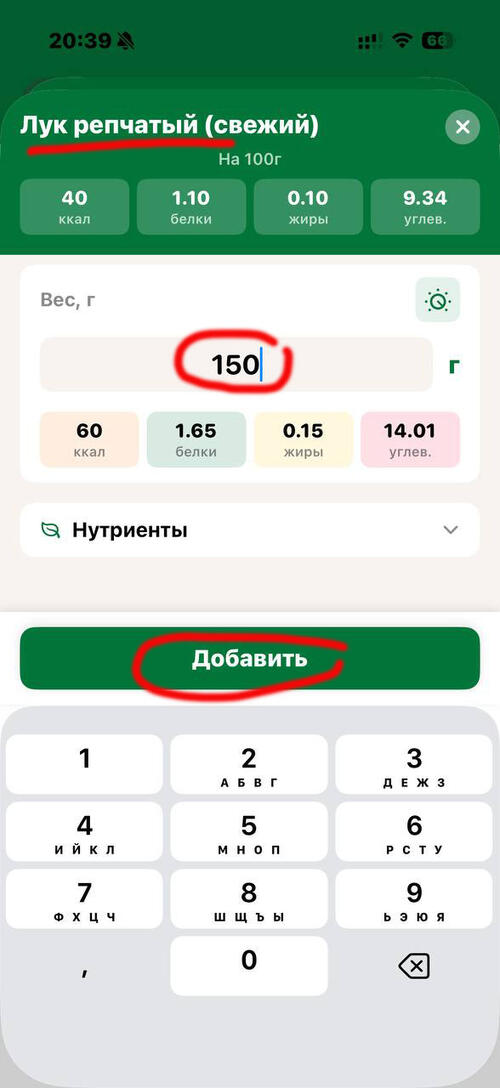
Add each ingredient separately. Start entering the name of the product and choose the correct option from the pop-up list. Then enter the exact weight of the product.
-
Be sure to include oil, sauces, cheese, cream, and other high-calorie additions.
-
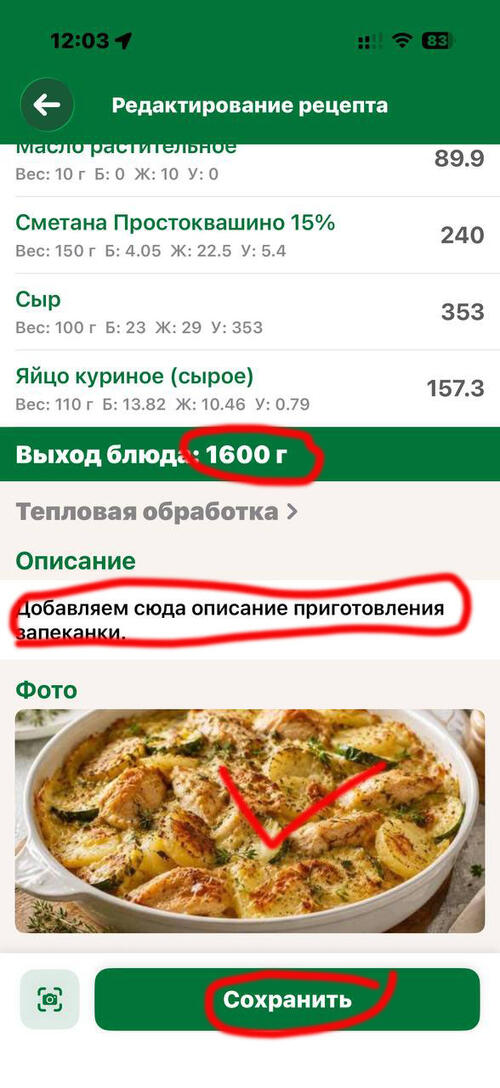
After cooking, weigh the entire finished dish and enter its actual weight, i.e. the yield of the dish. If desired, you can add a description of the cooking process and a photo.
-
Save the recipe.
When you want to add the dish to your food diary, find it in the product list and enter the weight of your portion.
For example, SIT30 calculated 124.7 kcal per 100 g for the casserole. You put 275 g on your plate. The app will automatically calculate the calories in your portion.
If you cook the dish again using the same ingredients, but the final weight changes significantly, it's best to update the finished yield of the recipe. This is especially important for soups, pilaf, porridge, and casseroles.
How to Calculate the Calories in Soup
Soup is calculated using the same formula, but it’s especially important to consider the final weight.
The recipe includes:
-
meat or fish;
-
potatoes;
-
grains or pasta;
-
vegetables;
-
oil for frying;
-
cream or cheese;
-
broth additions;
-
water.
Plain water contains 0 kcal, but it affects the kcal content of soup per 100 g.
For example, all the products in the pot contain 1350 kcal. After cooking, the soup weighs 3000 g:
1350 ÷ 3000 × 100 = 45 kcal per 100 g.
A bowl of soup weighing 400 g will contain:
45 × 400 ÷ 100 = 180 kcal.
If some of the water evaporates and the soup weighs not 3000, but 2500 g:
1350 ÷ 2500 × 100 = 54 kcal per 100 g.
That’s why you can’t just count the ingredients once and then roughly divide the soup by the number of bowls. Bowls can vary in volume, and the amount of water in the pot changes.
Do You Need to Count Water in the Soup?
You don't need to add water as a source of calories. But its weight should be included by way of the final weight of the finished soup.
The simplest way:
-
Add up the calories of all the ingredients.
-
Cook the soup.
-
Weigh the whole pot.
-
Subtract the weight of the empty pot.
-
Calculate calories per 100 g.
If you add another 300 g water to a thick soup the next day, the dish’s weight changes. For maximum accuracy, weigh the soup again and update the final recipe yield.
How to Count Calories in Pilaf
Pilaf is most often miscalculated because of rice and oil.
For calculation, weigh:
-
dry rice;
-
raw meat;
-
carrots;
-
onions;
-
vegetable oil;
-
additional ingredients.
The water added to cook the rice does not increase the total calories of the pilaf. It only changes its weight.
After cooking, weigh the entire pilaf and calculate the calories per 100 g.
Do not add both dry rice and cooked rice to a single recipe. Choose whichever you actually weighed.
Special attention should be paid to oil. Even a small difference in oil volume can noticeably change the calories in pilaf. It's best to place the oil bottle on the scale before and after cooking. The weight difference shows how much oil was used.
If some of the fat or oil was drained and not included in the finished dish, you can deduct it. But for regular home calculation, it’s simpler to count all the added oil. This gives a stable and somewhat more cautious result.
How to Count Calories in Salad
Salad usually doesn’t lose much water during preparation, so it's easier to calculate.
Add up the calories from:
-
vegetables;
-
meat, fish, or seafood;
-
eggs;
-
cheese;
-
avocado;
-
nuts and seeds;
-
croutons;
-
oil;
-
mayonnaise;
-
sour cream;
-
yogurt;
-
sauces.
The dressing is often the most calorie-dense part of the salad.
For example, cucumbers, tomatoes, and greens may total less than 100 kcal, but 20 g of oil adds about 180 kcal.
After mixing, you can weigh the whole salad and calculate calories per 100 g. This is convenient if several people share the salad or eat it throughout the day.
For a single-portion salad prepared directly on one plate, simply add up the calories of all the ingredients. It's not necessary to weigh the finished portion separately.
What Happens to Calories When Water Evaporates
Water evaporation does not increase the total calories of the dish.
Imagine a vegetable stew contains 800 kcal and weighs 1600 g:
800 ÷ 1600 × 100 = 50 kcal per 100 g.
After additional simmering, 300 g of water has evaporated. The stew now weighs 1300 g:
800 ÷ 1300 × 100 = 61.5 kcal per 100 g.
There are still roughly 800 kcal in the whole pot. But now every 100 g contains more product and less water.
The reverse happens with soup. If you add water, the total calories don't change, but the calories per 100 g drop.
Does the Total Calorie Amount Always Stay the Same?
In most home calculations, the total calories of a dish are considered equal to the sum of the calories of all the added ingredients. But there are exceptions.
Some Oil Was Left on the Pan
It can be difficult to determine the exact amount of oil eaten. You can either count all the oil added or weigh the pan before and after cooking.
For weight control, it's more important to use the same method consistently than to try to get the result to a single calorie every time.
Fat Rendered Out and Was Poured Off
If you pour off a noticeable amount of fat after cooking meat, the actual calories of the dish will be lower than the initial calculation.
For a more accurate result, you can weigh the drained fat and roughly subtract its calories.
Broth or Sauce Was Not Eaten
If some calorie-dense sauce remains in the dish, pot, or on the plate, you will actually consume fewer calories. But accurately calculating this difference in advance is almost impossible.
Products With Bones or Peels Were Used
Only the edible part of the product should be added to the recipe. Bones, thick peels, shells, and other inedible parts should not be counted.
For example, weigh the egg without the shell, and for meat on the bone, it's best to use the weight of the eaten part.
Do You Need to Create a New Recipe Every Time?
If the composition and quantity of products hardly change, you can use the saved recipe again.
A small difference in the amount of onion, greens, or water usually does not cause significant error. But a recipe should be recalculated if these change:
-
amount of oil;
-
fat content of meat;
-
type and quantity of grain;
-
amount of cheese;
-
type of dressing;
-
the size of the whole portion;
-
method of preparation.
For example, a casserole with 50 g and one with 150 g of cheese will have different calorie content. Pilaf with 20 g and 80 g of oil should not be considered the same recipe.
Common Mistakes When Calculating Complex Dishes
Forgetting to Include Oil
The oil used for frying onions, greasing a dish, or dressing a salad must be included in the total calories.
Using Raw Ingredient Weight Instead of Cooked Weight
Total raw weight is not suitable for calculating calories per 100 g after cooking. Some water may have evaporated or, conversely, been absorbed.
Confusing Dry and Cooked Grains
If rice was weighed dry, then you should enter dry rice into the database. Cooked rice has different calories per 100 g due to absorbed water.
Estimating Portions by Eye
One bowl of soup can weigh 300 g, another 500 g. One piece of casserole can be almost twice as heavy as another.
It’s more reliable to determine calories per 100 g and then weigh each portion.
Forgetting Sauces and Dressings
Sour cream, mayonnaise, cream, cheese sauce, nuts, and oil may contain more calories than the main vegetables in a dish.
Using Someone Else's Recipe Without Checking the Ingredients
Homemade pilaf or borscht can greatly differ between people in the amount of meat, grain, oil, and water. For accurate calculation, it's better to create your own recipe.
Quick Guide
To correctly calculate the calories in soup, pilaf, salad, casserole, or other complex dishes:
-
Weigh all the ingredients.
-
Find the calories per 100 g for each ingredient.
-
Include oil, sauces, and dressings.
-
Add up the calories of all ingredients.
-
Cook the dish.
-
Weigh the finished dish, without the cookware.
-
Divide total calories by the finished weight.
-
Calculate the value per 100 g.
-
Save the recipe in SIT30.
-
Weigh only your own portion.
It may seem time-consuming the first time you do it. In practice, the main work is done once. After saving the recipe in the app, tracking homemade soup, pilaf, or casserole takes just a few seconds.
FAQ
How do I calculate the total calories in a complex dish?
Multiply the weight of each ingredient by its calories per 100 g and divide by 100. Then add up the calories of all the ingredients, including oil, sauces, and dressings.
How do I calculate the calories in the finished dish per 100 g?
Divide the total calories of all ingredients by the weight of the finished dish and multiply the result by 100.
Should I count water in soup?
Water contains 0 kcal, so you do not need to add calories for it. But the amount of water affects the final weight of the soup and its calories per 100 g.
Does evaporation of water change the number of calories?
The total calories in the dish hardly change, but the weight decreases. Therefore, the calories per 100 g become higher.
Do I need to weigh the dish after cooking?
Yes. The final weight is necessary for the correct calculation of calories per 100 g. This is especially important for soups, porridge, pilaf, stews, and casseroles.
How do I count the calories in a portion of soup or casserole?
First, determine the calories per 100 g of the dish. Then multiply that by the weight of your portion and divide by 100.
How do I count oil if some of it stays in the pan?
For a simple and consistent calculation, you can count all the oil you add. For greater accuracy, you can weigh the pan or dish before and after cooking.
Can I save the dish calculation in SIT30?
Yes. Add the ingredients to your own recipe, specify their weights and the yield of the finished dish. After saving, simply select the recipe and enter the weight of the portion eaten.