Nutrition around workouts isn’t “magic,” but it really does affect your well-being, workout quality, and recovery. The main goal is simple: provide energy for the workout and meet your protein and fluid needs afterwards. Weight loss will still depend on the calorie deficit per day and week.
Swimming is excellent for weight loss if the main principle is followed: weight loss results from a calorie deficit, and the pool helps create and maintain this deficit thanks to energy expenditure, improved endurance, and reduced stress.
Benefits of swimming for those trying to lose weight:
minimal impact load on joints, comfortable for excess weight
the whole body works, overall endurance increases
easy to regulate intensity: from relaxed laps to interval segments
often helps to “unload your mind,” meaning less overeating due to stress
The main goal for a beginner is not speed or miles. The main goal is to turn running into a habit and not quit after a week. If you start gently and gradually increase your workload, your body will adapt, your breathing will become steadier, and your legs will stop feeling heavy.
A healthy activity benchmark is 150 minutes of moderate activity per week or 75 minutes of vigorous effort, plus strength training twice a week. Running can cover part of these minutes, but for a beginner it’s better to start by alternating running with walking.
Sports help you lose weight, but they are not the only factor. Weight goes down when there’s a calorie deficit, and sports make achieving a deficit easier: they increase energy expenditure, improve body shape, and reduce stress. Therefore, the best sport for weight loss is the one you can do regularly for 8-12 weeks, not the one that looks perfect on paper.
Why Strength Training Becomes Especially Important After 35
After the age of 35, the body starts to react more strongly to physical inactivity, lack of sleep, and stress. Strength training helps maintain muscle mass, support bone density, improve posture, and enhance movement quality. Plus, it’s one of the most reliable ways to tone your body without endless cardio.
It's important to understand: Age itself is not a restriction. The limitation is more often found in technique, recovery, and a smart training load, not in the number on your passport.
The goal of 7,000 steps a day often turns out to be the most practical: it noticeably increases activity, is easier to maintain for months, and doesn’t require you to “live on a walk.” For health, studies show that the benefit increases with the number of steps, but for many people, the effect begins to slow down somewhere around the range of 7,000-10,000 steps (depending on age and initial activity level).
Short summary:
7,000 steps a day is a strong foundational goal, especially if you currently walk very little.
In a study of middle-aged adults, 7,000+ steps per day were associated with a significantly lower risk of mortality compared to fewer steps.
For weight loss, steps work through energy expenditure and discipline, but the result is determined by a calorie deficit.
The goal of 10,000 steps a day became popular not because it’s a perfect medical norm, but because it’s a convenient, round number. Historically, it originated from the Japanese pedometer Manpo-kei and was more of a marketing guideline. Good news: you don’t have to hit 10,000 every single day to benefit. At the same time, 10,000 can be a great weight loss goal if it helps you maintain a calorie deficit and regular activity.
Short summary:
For health, the benefits of steps increase, but for many people the effect starts to slow down after about 6,000–8,000 steps for those 60+ and 8,000–10,000 for people under 60.
For weight loss, steps work through energy expenditure and discipline, but food choices and deficit are what really matter.
Intensity can be assessed simply: at moderate intensity, you can talk but can’t sing.
The "12,000 steps a day" challenge is often seen as a golden middle ground between the standard 10,000 and the advanced 15,000–20,000. For weight loss, this is a truly effective goal because it significantly increases daily energy expenditure and helps maintain a calorie deficit. But it's important to remember: when it comes to health, most benefits are often achieved at lower step counts, and after that the effect increases more slowly and depends on age and starting activity level.
In short:
12,000 steps a day can be a great goal for weight loss if you introduce it gradually and monitor your diet.
For health, about 6,000–8,000 steps is enough for people 60+, and around 8,000–10,000 for those younger than 60.
Intensity matters too: a guideline for moderate activity is about 100 steps per minute.


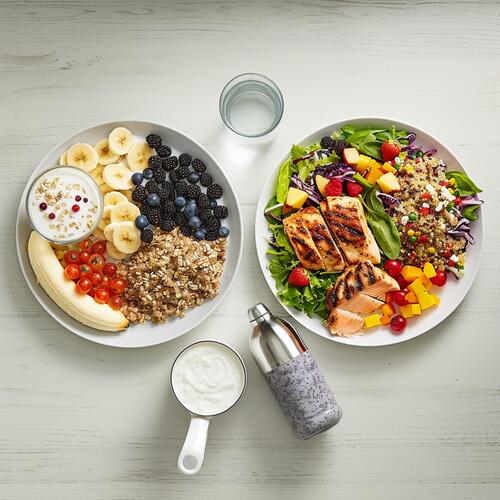 Nutrition around workouts isn’t “magic,” but it really does affect your well-being, workout quality, and recovery. The main goal is simple: provide energy for the workout and meet your protein and fluid needs afterwards. Weight loss will still depend on the calorie deficit per day and week.
 Swimming for Weight Loss: Does it Work or Not?
 What’s Important to Understand Before Starting
 The Main Truth About Weight Loss and Sports
 Why Strength Training at Home Really Works
 You don't need a perfect fitness routine to lose weight. You need a minimum that you can consistently do every week.
 Why Strength Training Becomes Especially Important After 35
 The goal of 7,000 steps a day often turns out to be the most practical: it noticeably increases activity, is easier to maintain for months, and doesn’t require you to “live on a walk.” For health, studies show that the benefit increases with the number of steps, but for many people, the effect begins to slow down somewhere around the range of 7,000-10,000 steps (depending on age and initial activity level).
 The goal of 10,000 steps a day became popular not because it’s a perfect medical norm, but because it’s a convenient, round number. Historically, it originated from the Japanese pedometer Manpo-kei and was more of a marketing guideline.
  The "12,000 steps a day" challenge is often seen as a golden middle ground between the standard 10,000 and the advanced 15,000–20,000. For weight loss, this is a truly effective goal because it significantly increases daily energy expenditure and helps maintain a calorie deficit. But it's important to remember: when it comes to health, most benefits are often achieved at lower step counts, and after that the effect increases more slowly and depends on age and starting activity level.