Bone Broth: Benefits and Harms, Recipe, How to Cook Properly
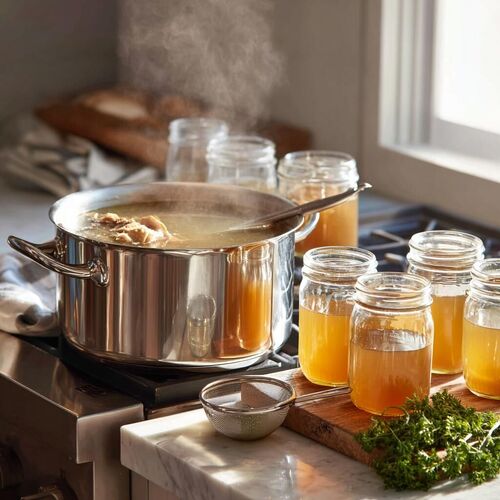 Bone Broth: Benefits, Recipe, and How to Cook at Home
Bone broth is a rich broth made from bones (often with joints and cartilage) through slow simmering over a long period. It is valued for its taste, gelatinous texture, and convenience: it is a basic ingredient for soups, sauces, and low-calorie snacks.
Below, we'll discuss which benefits of bone broth are truly supported by evidence, where marketing exaggerates, how to cook it deliciously and safely, and important details about salt, storage, and risks.
What’s Actually Healthy about Bone Broth
1) Protein and Amino Acids, but the Amount Depends Greatly on the Recipe
Bone broth contains amino acids, including glycine, proline, and others, which are associated with collagen. However, concentrations and the resulting protein content vary significantly: it depends on the type of bones, simmering time, amount of meat, water volume, and how much the broth is reduced. Studies directly note the variability of amino acid content and that bone broth does not provide reliable doses of “collagen precursors” as seen in studies on collagen supplements.
Practical takeaway: bone broth can be considered a pleasant additional source of protein, but you should not expect a “collagen supplement effect” from it.
2) Joints, Skin, Ligaments: Evidence is Mostly about Collagen Supplements, Not Broth
There are indeed clinical studies on supplements concerning joints and collagen, where some people report pain or discomfort reduction.
However, this does not mean “bone broth heals joints,” because supplements have standardized doses and composition, while broth does not.
3) Gut and “Mucosal Healing”: Promising, but Little Data on Humans
Bone broth contains amino acids and minerals, which theoretically could support the barrier functions of the gut, and there are reviews that discuss this.
However, much of the experimental work is performed on animal models (for example, anti-inflammatory effects in colitis models), so translating these results to humans should be done with caution.
4) Minerals: Expectations Are Usually Overstated
Bone broth is often advertised as a “source of calcium and magnesium,” but research shows that the actual mineral content is usually low and depends greatly on how it's prepared.
Risks and Who Might Not Benefit from Bone Broth
1) Salt and Blood Pressure
Store-bought broths and bone broths can be high in salt. Harvard Health notes that some options provide more than 450 mg of sodium per cup.
If you have hypertension, edema, or are advised to limit salt, choose broths without salt and add salt to taste at the table, or prepare your own broth at home without salt.
2) Heavy Metals: Results Are Mixed, but There Are Nuances
There is a pilot study where chicken bone broth showed higher concentrations of lead compared to the water it was cooked in.
There are also later studies on metals which conclude that lead and cadmium levels per serving are low and the risk is minimal for most people; the amount extracted depends on acidity, time, and bone type.
Practical takeaway: if you drink bone broth by the liter every day, it makes sense to reduce the frequency. Pregnant women, children, and people with kidney disease should discuss regular consumption with their doctor.
3) Individual Tolerance
Some people experience discomfort from rich, long-simmered broths (for example, due to histamine sensitivity). There’s a lot of controversy and no single clinical standard on this topic, so listen to your symptoms and, if needed, opt for a shorter cooking time or use a pressure cooker.
Bone Broth and Weight Loss: How to Use It Wisely
-
It’s a low-calorie base that makes it easy to “bulk up” your meals: soups, stewing vegetables, sauces.
-
As a snack: a cup of warm broth can reduce cravings for sweets and help you hold off until your next meal without pastries, but watch the salt content.
-
Do not use it as a meal replacement on a regular basis: broth is low in fiber, vitamins, and usually does not contain enough protein to meet daily requirements.
How to Cook Bone Broth: Basic Recipe
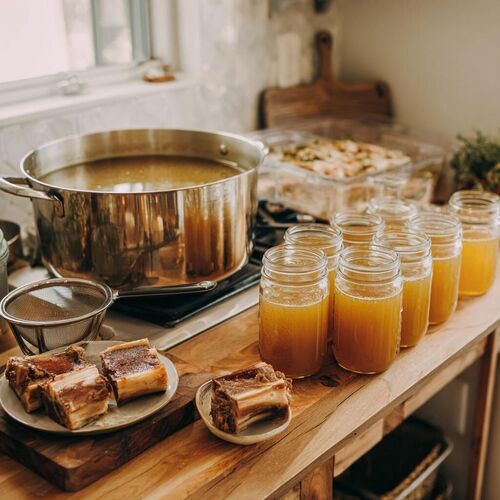 Below is a universal recipe suitable for both chicken and beef. The simmering time will differ.
Ingredients (for 3.5-4 liters)
-
Bones: 1.5–2 kg
Suitable options: beef joint bones, marrow bones, chicken carcasses, wings, feet (provide more gelatin) -
Water: 3.5–4 L (to cover the bones by 3–5 cm)
-
Onion: 1 pcs (150–200 g), large pieces
-
Carrot: 1 pcs (100–150 g), large pieces
-
Celery: 1–2 stalks (optional)
-
Garlic: 2–3 cloves (optional)
-
Bay leaf: 1–2 pcs
-
Black peppercorns: 6–10 pcs
-
Apple cider vinegar or lemon juice: 1 tbsp (optional)
-
Salt: Best not to add while cooking; add salt when serving
Note about acidity: it can enhance mineral extraction, but acidity also affects metal extraction. If this is important to you, cook without acid.
Step-by-Step Cooking on the Stove
Step 1. Preparing the Bones (optional, but enhances flavor)
-
Preheat the oven to 200°C.
-
Place the bones on a baking sheet and roast for 25–40 minutes until browned.
This gives a deeper flavor and color.
Chicken bones can be used without roasting if you want the broth to be as “light” as possible.
Step 2. Initial Heating and Skimming
-
Transfer the bones to a large pot and cover with cold water.
-
Bring almost to a boil, skim off foam for 5–10 minutes.
-
Reduce heat to a gentle simmer: surface should “just move,” without a full boil.
Step 3. Simmering
Add vegetables and spices.
Time:
-
Chicken bone broth: 6–12 hours
-
Beef: 12–24 hours
If you're cooking on the stove, it's convenient to make it during the day and then cool it overnight.
Step 4. Straining and Skimming Fat
-
Strain through a sieve.
-
Cool. The fat will congeal on top and can be easily removed with a spoon (leave some for flavor, if desired).
Step 5. Store Safely
The key rule: cool quickly and store in the refrigerator.
The USDA recommends cooling and placing in the refrigerator within 2 hours. It’s convenient to pour the broth into shallow containers.
The FDA for food services provides similar phased cooling guidelines; the main point is not to leave broth in the “danger zone” temperature range for long.
In a Multicooker or Pressure Cooker: Easier and More Consistent
Multicooker
-
“Stew” or “Soup” mode, gentle simmering
-
Chicken: 8–12 hours
-
Beef: 12–24 hours
Pressure Cooker
-
2–3 hours usually gives a rich, gelatinous result
-
Convenient if you don’t want long simmering and the smell in the kitchen
How to Know If Your Broth Is “Just Right”
Signs:
-
After cooling, it becomes thick or jelly-like (this is gelatin, not “pure collagen”)
-
The taste is rich, without bitterness
-
There’s a moderate amount of fat on top, not a “film over the whole container” (you can remove excess fat)
If it tastes bitter: the common causes are over-roasted bones, too vigorous boiling, or too much bay leaf cooked for too long.
How to Use Bone Broth
-
Soups and stews instead of water
-
Sauces and gravies
-
Cooking grains (rice, buckwheat)
-
A warm cup of broth as a snack
If you're losing weight, a helpful tip: add salt in your bowl and control the extras (oil, noodles, croutons), as these are what usually “add calories.”
FAQ
How long should you simmer bone broth?
Chicken is usually 6–12 hours, beef 12–24 hours on a low simmer. In a pressure cooker, 2–3 hours is often enough.
Do you need to add vinegar?
Not necessary. It can affect mineral extraction, but acidity also influences the extraction of other elements. If in doubt, cook without acid.
Is it true that bone broth heals joints?
Broth can be a source of amino acids, but reliable clinical effects are more often shown with standardized collagen supplements, while the composition of broth is inconsistent.
Is there a risk of heavy metals?
Studies offer mixed results: one found lead increased compared to water, and others found toxic metal levels per serving to be low. Extraction depends on preparation conditions.
How do you store bone broth safely?
Cool quickly, pour into shallow containers, and refrigerate within 2 hours.
Read Also in the SYPB 30 Blog
-
How to Count Calories Properly: Scales, Portions, Butter, and Drinks
-
Calorie Norm for Weight Loss: Calculation by the Mifflin St. Jeor Formula
-
Calorie Deficit: Which One to Choose and Why Too Little Often Backfires
- Healthy Eating Cottage Cheese Desserts: 12 Delicious Recipes Without Sugar or Extra Calories