

How to Count Calories Correctly: Scales, Portions, Oil, and Drinks
 How to Count Calories Correctly: Scales, Portions, Oil, Drinks
Calorie counting works only under one condition: if you count them truly correctly. In practice, most people "are in a deficit" but the weight doesn’t go down precisely because of accounting errors. Oil, drinks, snacks, and inaccurate portions easily bring the deficit to zero.
In this article, we’ll look at how to count calories properly, what you absolutely must pay attention to, and how to simplify the process so it doesn’t turn into constant stress.
Why Calories Are Counted Incorrectly
The main reasons are the same:
-
Weighing “by eye”
-
Ignoring oil and sauces
-
Underestimating drinks
-
Confusing raw and cooked products
-
Rare or incomplete tracking
Calorie counting is not about perfect gram-precision, but about consistency. An error of 20-30 kcal is not critical. An error of 300-500 kcal every day completely ruins the result.
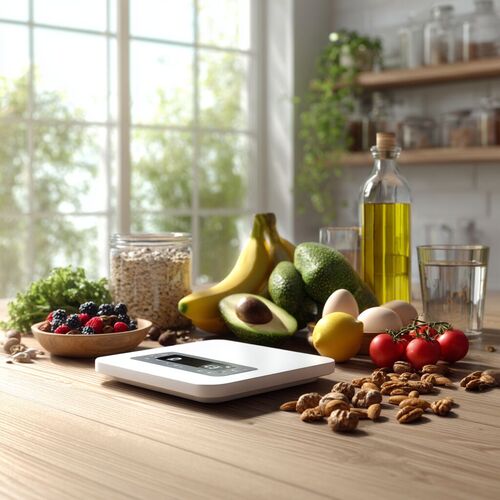
Kitchen Scales Are the Foundation
If you’re not using kitchen scales, you’re not counting calories—you’re guessing.
What’s important:
-
Weigh foods before cooking, if possible.
-
Use grams, not spoons, cups, and “pieces”.
-
Weigh every ingredient, not just the main product.
Example:
-
“Chicken breast 150 g” easily turns into 220 g without scales.
-
The difference is about 120 kcal, which usually goes uncounted.
SYPB 30 Calorie Counter simplifies the process: you enter the weight of the product, and the app automatically calculates calories and macronutrients.
Raw or Cooked Product: Choose One Approach
One of the most common mistakes.
Important:
-
Raw and cooked products have different calorie content per 100 g because of water content.
-
After boiling, frying, or baking, the weight changes, but the calories don’t.
Rules:
-
If you weigh it raw, always select the raw product in the database.
-
If you weigh it cooked, select the cooked version from the database.
-
Do not mix these approaches in one meal.
It’s easiest to pick one method and stick to it consistently. SYPB 30 offers options for both raw and cooked products, reducing the risk of mistakes.
Portions “By Eye” Don’t Work
Even with experience, people systematically make mistakes.
Typical examples:
-
“A handful of nuts” is 40-60 g instead of the expected 20 g.
-
“One spoon of porridge” easily becomes two.
-
“A slice of cheese” often weighs 35-40 g, not 20.
For the first 2-3 weeks, it’s better to weigh everything. Over time, your eye becomes more accurate, but control is still needed, especially with calorie-dense foods.
Oils, Sauces, and Dressings
This is the main enemy of calorie deficit.
Facts:
-
1 tablespoon of oil is about 90-120 kcal.
-
Oil is often not counted at all or calculated as “just a little”.
-
Sauces and dressings can silently add 200-300 kcal to a dish.
How to count them correctly:
-
Weigh the oil before adding.
-
Or weigh the bottle before and after cooking.
-
Account for mayonnaise, ketchup, soy sauce, cream, salad dressings.
Even with a perfect meal plan, without counting oil, weight loss can come to a complete stop.
Drinks Count Too
A very common mistake: “I didn’t eat anything.”
In reality:
-
Coffee with milk and sugar
-
Tea with honey
-
Juices
-
Smoothies
-
Alcohol
All of these are calories.
Example:
-
A latte with syrup can easily provide 200-250 kcal.
-
A glass of juice is 100-120 kcal.
-
A glass of wine is about 120-150 kcal.
If drinks are not counted, the deficit almost always turns out to be an illusion. In SYPB 30, drinks are tracked just like food, helping you see the real daily picture.
Snacks and “Nibbling”
Another hidden problem.
What’s usually forgotten:
-
A piece of cheese
-
A candy “automatically”
-
Cookies with tea
-
Finishing food after a child
-
Tasting a dish while cooking
Each such episode can be 30-100 kcal. Over a day, this can easily add up to 300+ kcal that aren’t tracked anywhere.
The rule is simple: if something goes in your mouth, it counts.
How Accurate Your Counting Should Be
Perfect accuracy doesn’t exist—and it’s not needed.
Guidelines:
-
An error of up to 5-10% is acceptable.
-
Systematic errors are not allowed.
-
What matters is the average calorie intake for the week, not for just one day.
It’s better to count consistently and a bit imprecisely than perfectly for two days and then give up.
How to Make Calorie Counting Easier
So you don’t get tired of counting:
-
Use the same breakfasts and lunches.
-
Create your own dishes in the app.
-
Save favorite products.
-
Don’t recalculate the same thing every day.
SYPB 30 Calorie Counter solves this problem: foods, dishes, and meals are saved, and the calorie norm is calculated automatically.
Common Mistakes in Calorie Counting
-
Don’t weigh oil.
-
Don’t track drinks.
-
Count “by eye”.
-
Mix up raw and cooked products.
-
Don’t count all snacks.
-
Look only at a single day’s calories instead of the week’s average.
Short Summary
Proper calorie counting includes:
-
Kitchen scales
-
Tracking oil and sauces
-
Tracking drinks
-
Honest tracking of snacks
-
Consistency
If these conditions are met, a calorie deficit almost always works.
And you can read about how to calculate your own calorie norm and deficit properly in the article: "Calorie Norm for Weight Loss: How to Calculate (Formula, Example, Common Mistakes)"