

How to Count Calories When Cooking for the Whole Family: A Simple Guide
 How to Count Calories When Cooking for the Whole Family
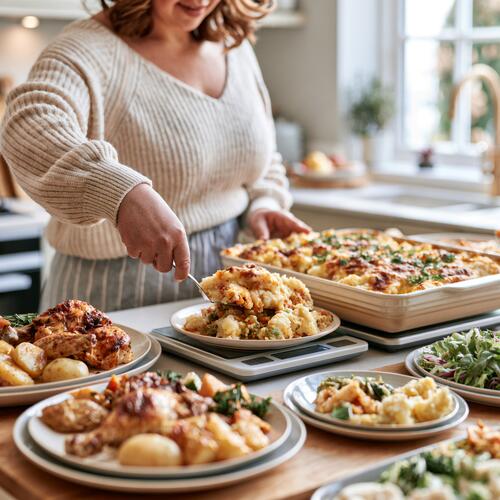
It's not necessary to make a separate chicken breast for yourself, a separate pot of buckwheat, and a personal salad. You can eat the same homemade food as other family members and still accurately monitor your calorie intake.
The main thing is not to try to estimate calories just by the size of your plate. You need to calculate the total dish once, determine its calorie content per 100 g, and then weigh only your portion.
This method is suitable for soups, pilaf, casseroles, cutlets, stewed meat, pasta with sauce, and other dishes that are cooked for several people at once.
The Main Rule of Family Calorie Counting
Cooking for the whole family doesn't change the principle of calculation:
-
Weigh the ingredients you put in the dish.
-
Include oil, sauces, and other high-calorie add-ins.
-
After cooking, weigh the entire finished dish.
-
Calculate the calories per 100 g.
-
Weigh your portion.
-
Add it to your food diary.
You don't need to divide the pot into four or five equal parts in advance. One family member's portion can weigh 200 g, another's 350 g, and a third's 500 g. Each will get a different number of calories, even if eating the same dish.
Do You Need to Cook Separately If You're Losing Weight?
In most cases, no.
One family dish can be shared among everyone by adjusting portion size and side items.
For example, for dinner you have prepared:
-
baked chicken;
-
potatoes;
-
vegetable salad;
-
sauce;
-
bread.
The person who is counting calories can have more vegetables, a moderate portion of chicken and potatoes, and weigh the sauce and bread separately. Other family members may have more side dishes or add their own foods.
This gives you one common dinner, but plates of varying sizes and calories.
Three Ways to Count Family Meals
Your method will depend on how the food is cooked and served.
Method 1. All Foods Are Served Separately
This is the easiest option.
For example, you made:
-
chicken fillet;
-
buckwheat;
-
vegetable salad;
-
sauce.
Weigh each component on your plate:
-
chicken fillet: 130 g;
-
cooked buckwheat: 150 g;
-
salad: 250 g;
-
sauce: 25 g.
After that, add the foods to SIT30 separately.
It's important to select the food option in the database that matches the way you weighed it. If you're weighing cooked buckwheat, select cooked or boiled buckwheat. If you're entering dry groats in the recipe before cooking, use the dry product data.
Mixing raw and cooked weights is one of the most common causes of inaccurate calculations. After boiling or baking, the water content and product weight change, so the calories per 100 g also change.
Method 2. All Ingredients Are Mixed Together
This is how you count soups, pilaf, stews, casseroles, salads with dressing, sauteed vegetables with meat, and other complex dishes.
First, calculate the total calories of the entire pot or baking dish, then determine the calories per 100 g.
Formula:
Calories per 100 g = total calories of the dish ÷ weight of the finished dish × 100
Your portion's calories:
Portion calories = calories per 100 g × portion weight ÷ 100
For such dishes, it's easier to create your own recipe in SIT30. You can enter the ingredients, their amount, the method of processing, and the final weight of the cooked dish into the app. The SIT30 recipe module takes into account changes in ingredient weight after cooking.
A detailed calculation of soups, pilaf, salads, and casseroles is covered in a separate article:
How to Count Calories in Complex Dishes: Soups, Pilaf, Salads, and Casseroles
Method 3. The Dish Consists of Separate Pieces
This way you can count:
-
cutlets;
-
cheese pancakes (syrniki);
-
pancakes;
-
stuffed cabbage rolls;
-
stuffed peppers;
-
homemade pies;
-
pieces of casserole.
There are two calculation options.
By Number of Pieces
If all pieces turned out roughly the same, you can divide the total calories by the number of pieces.
For example:
-
total calories of cutlets: 1800 kcal;
-
you made: 15 cutlets;
-
one cutlet: about 120 kcal.
This method is convenient, but not the most accurate. One cutlet might weigh 70 g, another 105 g.
By Weight
A more accurate method:
-
Weigh all the finished cutlets.
-
Calculate calories per 100 g.
-
Weigh the cutlets in your portion.
This way, the size of the pieces won't affect the accuracy of your tracking.
Step-by-Step Instructions: How to Calculate the Whole Pot
Let's consider a universal order of steps.
Step 1. Weigh the Empty Dish
Before cooking, weigh the empty pot, pan, or baking dish.
For example:
Empty dish weight: 1250 g
Write this number down. After cooking, you'll need to subtract it from the total weight.
Alternatively, place the empty dish on the scale, zero it, and then add the cooked food. But that's not always convenient, especially if the dish is hot.
Step 2. Weigh the Ingredients
Weigh foods in the state in which you add them to the recipe.
For a casserole, for example:
-
chicken fillet: 800 g;
-
potatoes: 1000 g;
-
carrot: 200 g;
-
onion: 150 g;
-
sour cream: 200 g;
-
vegetable oil: 20 g.
Vegetables and meat are usually easiest to weigh after cleaning, deboning, unwrapping, and other removal of inedible parts.
Step 3. Calculate the Calories of All Ingredients
Use the packaging information or the values from SIT30 foods.
Example calculation:
| Ingredient | Weight | Calories | Total Calories |
|---|---|---|---|
| Chicken fillet | 800 g | 110 kcal per 100 g | 880 kcal |
| Potatoes | 1000 g | 77 kcal per 100 g | 770 kcal |
| Carrot | 200 g | 35 kcal per 100 g | 70 kcal |
| Onion | 150 g | 40 kcal per 100 g | 60 kcal |
| Sour cream | 200 g | 162 kcal per 100 g | 324 kcal |
| Vegetable oil | 20 g | 900 kcal per 100 g | 180 kcal |
Total calories of the dish: 2284 kcal
The values are for illustration only. For actual calculation, use the specific manufacturer's information and the exact weight of products.
Step 4. Weigh the Cooked Dish
Suppose the dish with the finished casserole weighs 3300 g.
The empty dish weight was 1250 g.
3300 − 1250 = 2050 g
The weight of the cooked casserole without the dish is 2050 g.
Step 5. Calculate Calories per 100 g
Use the formula:
2284 ÷ 2050 × 100 = 111 kcal
There are about 111 kcal in 100 g of the finished casserole.
Step 6. Weigh Your Portion
Suppose you serve yourself 320 g of casserole.
111 × 320 ÷ 100 = 355 kcal
Your portion contains about 355 kcal.
Other family members can take any portion size. For your food diary, only the weight of the portion you ate matters.
Calorie Table for Portions
For the casserole in this example, calorie content is approximately 111 kcal per 100 g.
| Portion Weight | Calories |
|---|---|
| 150 g | 167 kcal |
| 200 g | 222 kcal |
| 250 g | 278 kcal |
| 300 g | 333 kcal |
| 350 g | 389 kcal |
| 400 g | 444 kcal |
Creating such a table is not necessary. After saving the recipe, SIT30 will calculate calories for any entered weight.
How to Count If the Family Adds Foods Directly to Their Plate
All individual add-ons need to be recorded separately.
These include:
-
sour cream;
-
mayonnaise;
-
ketchup;
-
cheese;
-
butter;
-
vegetable oil;
-
bread;
-
croutons;
-
nuts;
-
seeds;
-
sauces;
-
sugar;
-
honey.
For example, the calories in borscht have already been calculated. You add 20 g of sour cream to your bowl and ate 35 g of bread.
You enter three items in your diary:
-
Borscht: actual portion weight.
-
Sour cream: 20 g.
-
Bread: 35 g.
Do not add sour cream to the general borscht recipe if other family members add it themselves and in varying amounts.
How to Record Oil Used in a Shared Pan
You need to include oil in the recipe if it was used for the whole dish.
The most convenient way:
-
Put the oil bottle on the scale.
-
Write down its weight.
-
Add oil to the pan.
-
Weigh the bottle again.
-
The difference shows how much oil was used.
Example:
-
bottle before cooking: 824 g;
-
bottle after cooking: 812 g;
-
oil used: 12 g.
Add those 12 g to the general recipe.
Don't try to count only the oil you can see on the food surface. It's impossible to estimate the amount by eye.
If a significant amount of oil is left in the pan and you don't use it, calculating all the added oil may slightly overestimate calories. For everyday control, this is usually safer than forgetting about oil entirely.
What to Do About Water and Broth
Plain water doesn't add calories, but it affects the total weight and calorie content per 100 g of a dish.
For example, one pot of soup turns out thick, another has more water added. The total calorie content of the ingredients may be the same, but the calories per 100 g of soup will differ.
Therefore, soup must always be weighed after cooking.
It's not necessary to add plain water to the list of calorie-containing ingredients. The main thing is to indicate the correct final weight of the finished soup.
Milk, cream, coconut milk, juice, sweetened drinks, or ready-made broth with caloric value can’t be counted as plain water. They need to be added to the recipe as separate ingredients.
How to Count Meat and Fish with Bones
Don’t include the weight of the bones when the selected product lists calories only for the edible part.
There are two main approaches.
Option 1. Remove Meat from Bones Before Cooking
For example, cut the fillet away, weigh it, and add it to the recipe.
This is the most straightforward method.
Option 2. Weigh the Leftovers
If you baked a whole chicken:
-
Weigh the chicken before cooking.
-
After eating, gather up and weigh the bones and other inedible parts.
-
Subtract that weight.
-
Use the weight of the edible portion for calculations.
Keep in mind that meat loses weight during baking. For regular home tracking, it's usually easier just to weigh your portion of already deboned cooked meat and select the corresponding cooked product in the database.
How to Measure Soup with a Ladle
The number of ladles is an inexact measure. One ladle may be full, another only half. Also, one portion might get more meat and less broth.
It's better to put the bowl on the scale, zero it, and ladle in the soup. The scale will immediately display the portion's weight.
If it's inconvenient to weigh at the table, you can determine the average weight of a full ladle once. For example, a full ladle of your soup weighs about 120 g. Then two ladles are approximately 240 g.
This method is suitable for everyday rough estimates, but you should check with scales periodically for accuracy.
What to Do If the Dish Has Already Been Eaten
If some of the food was eaten before weighing, you can't get an absolutely accurate calculation.
You can choose one of the following:
-
add the approximate weight of the eaten portions to the remaining dish;
-
divide the total calories by the approximate number of portions;
-
find a similar homemade dish in the database and enter an estimated value;
-
record your portion with a slight overestimate.
One rough meal won’t ruin your weight loss results. More important is not letting such situations turn into a regular refusal to track.
In the future, weigh the pot as soon as you finish cooking, before serving the food.
Can You Just Divide the Dish by the Number of Family Members?
You can, but only if the portions are truly identical.
For example, you made 12 identical pancakes with a total calorie count of 1440 kcal.
1440 ÷ 12 = 120 kcal
One pancake contains about 120 kcal.
But dividing a pot of pilaf by four family members is wrong if one person ate a small bowl and another had a second helping.
In that situation, you need to count by weight.
How to Count Leftovers the Next Day
A saved recipe can be used as long as you’re eating the same prepared batch of food.
For example, today you made 2050 g of casserole at 111 kcal per 100 g. You ate one portion in the evening and refrigerated the rest.
The recipe remains the same next day. You only need to weigh out your new portion.
If, a week later, you make casserole again but vary the amount of potatoes, meat, sour cream, or oil, you’ll need to update the calculation. Even with the same name, the calorie content of two homemade dishes may differ.
It's convenient to copy the previous recipe and update only the changed ingredients and final weight.
How to Add a Family Dish to SIT30
The general steps are as follows:
-
Open the section to create your own recipe.
-
Enter the dish name.
-
Add all the ingredients and their actual weights.
-
Select the correct food type: raw, dry, boiled, or another suitable option.
-
Add oil, sauces, and high-calorie dressings.
-
Enter the weight of the finished dish.
-
Save the recipe.
-
Weigh your portion.
-
Add the actual amount eaten to your diary.
For example, you can save the recipe as:
Family Chicken and Potato Casserole
The next time your family makes this dish using the same proportions, you won’t need to create it from scratch.
How to Simplify Counting and Not Spend the Whole Evening with Scales
You don't have to measure every last crumb to monitor your diet.
Focus on foods that have the biggest impact on calories:
-
oil;
-
fatty meats;
-
cheese;
-
sour cream;
-
mayonnaise;
-
nuts;
-
grains;
-
pasta;
-
bread;
-
sweets;
-
sauces.
Water, salt, and a small amount of regular dry spices have virtually no effect on final calories. But pre-made mixes with sugar, starch, cheese powder, or oil are better to include.
A few more time-saving tips:
-
keep your scale on your work surface;
-
write down ingredient weights right away, not after cooking;
-
weigh oil by the change in bottle weight;
-
save frequently used recipes;
-
prepare the central part of the dish in bulk, and serve sauces and add-ons separately;
-
use the same baking dish or pot and note its weight for future use.
After a few weeks, the main steps will become habits and take just a few minutes.
Common Mistakes in Counting Family Meals
Forgetting to Include Oil
Even a small amount of oil can significantly change the total calories of a pot or baking dish.
Dividing the Dish Evenly Among Everyone
Family members rarely eat exactly the same amount of food. It's more accurate to weigh your actual portion.
Entering Raw Weight as Cooked
Dry pasta and cooked pasta have different calories per 100 g, since they absorb water when cooked.
Not Weighing the Finished Dish
Without the final weight, you can't accurately calculate calories per 100 g of soup, pilaf, or casserole.
Forgetting Add-ons in the Bowl
Sour cream, bread, cheese, and sauce may not be included in the main recipe but do contribute to your meal's total calories.
Using One Calculation for Different Recipes
The same dish name doesn't mean the same calories. Today’s stew may have had 10 g of oil, next time 30 g.
Trying to Achieve Laboratory Accuracy
Home counting always has a small margin of error. It's more important to use a consistent approach, include main ingredients, and not change your calculation rules every day.
Do You Need to Track Food for the Whole Family?
No. To monitor your own diet, it's enough to calculate the total dish and weigh only what you eat.
Other family members don’t need to keep a food diary or match your calorie intake. One person may take 200 g of casserole, another 400 g, a child 150 g.
The food remains shared. Only the portion size becomes individual.
The Bottom Line
To count calories when cooking for the whole family, you don't need to make separate dishes.
Use a simple scheme:
-
Weigh the ingredients.
-
Calculate the calories of the entire dish.
-
Include oil and sauces.
-
Weigh the dish after cooking.
-
Record the calories per 100 g.
-
Weigh your portion.
-
Add ingredients you put directly on your plate separately.
The SIT30 calorie counter helps you save a family recipe and then add any quantity of the dish to your diary. This allows you to keep making your usual homemade meals for everyone, enjoy family meals, and still keep your own nutrition under control.
Frequently Asked Questions
Do I need to cook separately when counting calories?
No. You can eat the same dish as the rest of the family. Calculate its calories per 100 g and then weigh your portion.
How do I count the calories in my portion from a shared pot?
First, determine the total calories and weight of the finished dish. Calculate the calories per 100 g, then multiply by your portion's weight and divide by 100.
How do I count calories if everyone eats different portion sizes?
Each portion must be weighed separately. Calorie intake depends not on the number of family members, but on the actual weight of food eaten.
How do I count cutlets, pancakes, and cheese pancakes?
If all pieces are identical, you can divide total calories by the number of pieces. For more accurate tracking, weigh the entire finished batch and then count each portion by weight.
Do I need to count the water in soup?
Water doesn't add calories, but it changes the weight of the soup and its calories per 100 g. So weigh the finished soup.
How to count oil added to a shared pan?
Add the total oil used to the main recipe. It's easiest to determine the amount by weighing the bottle before and after cooking.
What if I forgot to weigh the cooked dish?
Use the approximate number of portions or find a similar dish in the database. Next time, weigh the pot before serving the food.
Can I reuse a saved recipe?
Yes, if the ingredients, amounts, and final dish weight are about the same. If the recipe changes, update the calculation.