

How to Count Oil When Frying, Baking, and in Salads | SIT30
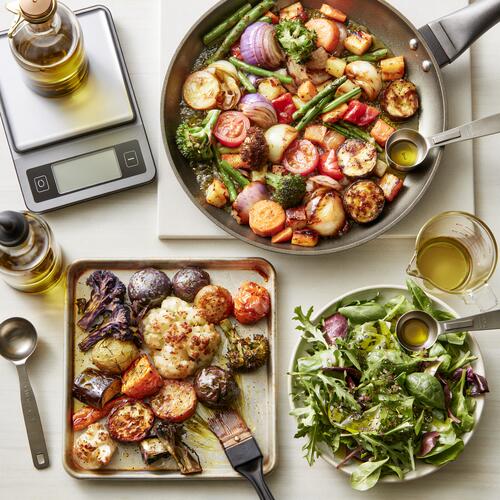 How to Account for Oil When Frying, Baking, and Dressing Salads
Oil often becomes the source of an unnoticed mistake in a food diary. A person carefully weighs meat, grains, and vegetables, but adds oil to the pan “by eye” or doesn’t log it at all. As a result, the actual calorie content of the dish turns out to be higher than calculated.
This is especially common when frying. Did all the oil stay in the pan or did some get absorbed by the food? Should you record the whole spoonful or just a few grams? How should you account for oil if the dish was prepared for the entire family?
Let's figure out how to calculate oil when frying, baking, and preparing salads so that you don't overstate or underestimate the calorie content of your meals.
Quick Answer
The main rule is as follows:
Account for the amount of oil that actually ended up in the finished dish.
In practice, you can use three approaches:
-
If the oil is fully mixed with the ingredients, count all the oil you added.
-
If a noticeable amount of oil remains in the cookware after cooking, you can subtract it.
-
If it’s impossible to accurately determine how much oil remains, count all the oil you added. This calculation will slightly overestimate calories, but avoids underestimating them by accident.
For accurate measurement, it’s better to measure oil in grams using a kitchen scale rather than in spoons.
Why It's Important to Account for Oil
Oil is mostly made up of fat. One gram of dietary fat provides about 9 kcal. That's why even a small amount of oil can noticeably affect a dish's calorie content.
Approximate calculation:
| Amount of oil | Calories |
|---|---|
| 3 g | about 27 kcal |
| 5 g | about 45 kcal |
| 10 g | about 90 kcal |
| 15 g | about 135 kcal |
| 20 g | about 180 kcal |
| 30 g | about 270 kcal |
The exact calorie content depends on the specific product. When entering oil in your food diary, use the data from the packaging or the value from the SIT30 calorie counter database.
Suppose you cooked vegetables with a calorie content of 150 kcal. If you add 20 g of oil, the total calorie content of the dish will increase to about 330 kcal.
This is why phrases like “lightly fry” and “add a little oil” are not suitable for accurate calculation.
How to Weigh Oil Correctly
Method 1. Weigh the Container Before and After
This is one of the most convenient methods.
-
Place the bottle of oil on the kitchen scale.
-
Record the weight.
-
Add oil to the pan, baking dish, or salad.
-
Place the bottle back on the scale.
-
Subtract the second weight from the first.
For example:
-
Bottle before cooking: 864 g;
-
Bottle after cooking: 854 g;
-
Used: 10 g of oil.
Enter 10 g in your diary.
This method is more convenient than placing a pan on the scale or trying to measure oil into a separate spoon.
Method 2. Weigh a Small Container
Put a cup or sauce dish on the scale, zero it, and pour in the desired amount of oil.
Then add the oil to the dish.
This method is suitable when you plan in advance to use a specific amount, such as 5 or 10 g.
Method 3. Weigh a Bottle with a Sprayer
Oil in a spray also contains calories. The “0 kcal” label on the package sometimes just refers to a very small serving size, not the absence of fat.
To determine usage:
-
Weigh the can or bottle before use.
-
Spray the oil onto the food.
-
Weigh the package again.
-
Record the difference.
If the scale does not detect any difference after one use, you can measure usage over several cookings and then divide by the number of uses.
How to Count Oil When Frying in a Pan
When frying, some oil may remain on the surface of the pan, some coats the food, and some is absorbed.
There is no universal percentage for absorption. The result depends on the product, breading, temperature, cooking duration, moisture content, and cooling method. Studies of the frying process also show that oil absorption involves a whole range of factors, so you can't use a rule like “the product always absorbs 20 percent of the oil.”
Simple Method
If you added 10 g of oil to the pan and after cooking there is no noticeable leftover, add all 10 g to the recipe.
This is the most practical approach for home calculation.
More Accurate Method
If a lot of oil remains in the pan after frying:
-
Record the amount of oil added before cooking.
-
Transfer the finished food to a plate.
-
Pour the remaining oil into a small container.
-
Weigh the leftover oil.
-
Subtract it from the initial amount.
Formula:
Oil in the finished dish = oil added minus measured leftover
Example:
-
15 g of oil added;
-
5 g drained after cooking;
-
10 g of oil should be included in the dish's calculation;
-
the calorie content of the oil in the dish is about 90 kcal.
It's hard to measure a thin film of oil on the pan. In this case, it's easier to count all the oil. The difference will usually be smaller than the error from trying to guess the leftover by eye.
Should You Count All the Oil You Poured into the Pan?
Count all the oil added in the following cases:
-
the oil is fully mixed with the food;
-
preparing an omelet, stew, sauté, or sauce;
-
there is no noticeable leftover after cooking;
-
the leftover oil cannot be separated and weighed;
-
you want to use a simple and consistent counting method.
You can subtract the leftover if there is a clearly measurable amount of oil remaining in the cookware after cooking.
It is not recommended to come up with your own absorption coefficient, such as logging half the oil without measurements. For one dish, half may truly remain in the pan, but for another, almost all may end up in the food.
Sample Calculation of Chicken Fillet
You are preparing two servings of chicken fillet.
Ingredients:
-
Chicken fillet: 400 g;
-
Vegetable oil: 12 g;
-
Spices and salt.
After cooking, almost no oil is left in the pan.
Add all 12 g to the recipe.
Approximate oil calorie content:
12 × 9 = 108 kcal
If the dish is divided into two equal portions, each portion accounts for:
108 ÷ 2 = 54 kcal from oil
Add about 54 kcal to each chicken portion's calorie count.
If the finished pieces differ in size, it is more accurate to weigh all cooked fillet and calculate per 100 g.
How to Calculate Oil for Cutlets, Syrniki, and Fritters
When preparing several batches, oil is often added to the pan gradually.
A common mistake is to record only the first portion of oil.
The correct procedure:
-
Weigh the bottle before you start cooking.
-
Fry all batches, adding oil as needed.
-
After finishing, weigh the bottle again.
-
Add the difference to the overall recipe.
-
Weigh all cooked cutlets, syrniki, or fritters.
-
Calculate calorie content per 100 g or divide by number of servings.
Example:
-
First batch used 7 g;
-
Second batch: 5 g;
-
Third batch: 4 g;
-
Total oil used: 16 g.
Add 16 g of oil to the recipe, not just 7 g.
If a noticeable amount remains in the pan, a measurable leftover can be subtracted.
How to Account for Oil in a Sauté
The oil from a sauté doesn't disappear after adding to a soup, pilaf, or stew. It becomes part of the overall recipe.
For example, for a soup you used:
-
Onion: 100 g;
-
Carrots: 100 g;
-
Oil: 15 g.
The sauté is fully transferred to the pot. So, all 15 g of oil should be included in the soup’s calorie count.
After cooking, you need to weigh or determine the total yield of the dish and calculate the calories per 100 g.
A detailed guide is provided in the article “How to Count Calories in a Complex Dish: Soup, Pilaf, Salad, and Casserole”.
How to Calculate Oil in Baking
When baking, oil can:
-
remain on the surface of foods;
-
mix with vegetable or meat juice;
-
go into the sauce;
-
partially remain on the baking dish, foil, or parchment.
Oil Applied to Products
If you mixed potatoes, vegetables, fish, or meat with oil, count the total amount you added.
For example:
-
Potatoes: 800 g;
-
Oil: 20 g;
-
Spices.
If all the oil was distributed on the potatoes, add all 20 g to the recipe.
Oil Was Only Used to Grease the Pan
It’s best to weigh the oil before application.
If you poured 5 g of oil and spread it with a brush, enter 5 g in the calculation. Even if a small amount remains on the pan, this approach is clear and repeatable.
A Lot of Oil and Juice Remain in the Pan
Separating pure oil from meat or vegetable juice at home is difficult. So, it’s safest to count all the oil you added.
You should not subtract all the liquid that stays in the pan. It consists not only of oil, but also water, juice from the foods, melted fat, and other components.
Sample Calculation for Roasted Vegetables
Ingredients:
-
Zucchini: 300 g;
-
Eggplant: 300 g;
-
Sweet pepper: 200 g;
-
Onion: 100 g;
-
Olive oil: 18 g;
-
Spices.
After baking, you have 700 g of the finished dish.
The oil remained fully in the vegetables and the sauce, so add all 18 g to the recipe.
Oil calories:
18 × 9 = about 162 kcal
Next, add up the calories of all ingredients and divide by the final yield.
Formula:
Calories per 100 g = total dish calories ÷ finished dish weight × 100
If the total calorie content of the vegetables with oil is 480 kcal:
480 ÷ 700 × 100 = about 69 kcal per 100 g
How to Calculate Oil in a Salad
Dressing a salad is simpler than frying. Oil does not evaporate and usually stays fully in the dish.
If 10 g of oil has been added to the salad, log 10 g in your calculation.
Don’t use “one spoonful” or “a little oil” as a measurement. The amount in a spoon depends on its size and how full it is.
The Salad Is Made for One Person
Add the oil as a separate item in the same meal.
For example:
-
Cucumber: 150 g;
-
Tomato: 150 g;
-
Oil: 7 g.
Log the vegetables and 7 g of oil in your diary.
The Salad Is Made for the Family
Create a shared recipe.
For example:
-
Vegetables and greens: 750 g;
-
Oil: 25 g;
-
Lemon juice: 20 g;
-
Mustard: 10 g.
Weigh the finished salad. Suppose it weighs 805 g.
Add all the ingredients to the recipe, specify a yield of 805 g, then weigh your serving.
If you ate 200 g of salad, the app will calculate the amount of each ingredient, including oil, per serving.
Some Dressing Remained in the Bowl
If a little dressing is left in the bowl after the salad, you usually don’t need to recalculate the recipe. It’s difficult to measure exactly.
If a lot of dressing is left and you want a more accurate result, you can prepare the dressing in a separate container ahead of time, weigh it, and add it by portion.
How to Account for a Complex Dressing
A salad dressing may include ingredients other than oil.
For example:
-
Olive oil: 15 g;
-
Honey: 8 g;
-
Mustard: 10 g;
-
Lemon juice: 20 g;
-
Soy sauce: 10 g.
Each ingredient must be entered separately in the recipe.
You cannot simply log this mixture as 15 g of oil, since honey and sauces can also contain calories.
If the dressing is made in advance:
-
Add all ingredients to a separate recipe.
-
Weigh the finished dressing.
-
Specify its total yield.
-
Add the required amount to your salad in grams.
How to Account for Butter, Clarified Butter, and Lard
The rules remain the same regardless of the type of fat used.
You should count:
-
Vegetable oil;
-
Olive oil;
-
Butter;
-
Clarified butter;
-
Coconut oil;
-
Margarine;
-
Lard;
-
Fat added during cooking.
Use the calorie content of the specific product you added. Butter contains not only fat, but also some water and other components, so its calorie content is different from vegetable oil.
If the meat releases its own fat during cooking, you don’t need to add it separately. It is already part of the raw meat, if you have selected the correct product from the database.
An exception arises if the rendered fat was drained and didn’t end up in the finished portion. In this case, a home calculation will still be approximate.
Should You Count Oil from Marinades?
Yes, if the marinade ended up in the finished dish.
For example, if the chicken was marinated in a mixture of oil and spices, and all the marinade was placed in the baking dish, you should add all the oil used to the recipe.
If a large portion of the marinade remained in the bowl and was discarded, you can just count the part that actually got onto the food. The easiest way:
-
Weigh the bowl with marinade before adding the meat.
-
After transferring the meat, weigh the bowl with the remaining marinade again.
-
Determine the difference.
However, in a marinade, oil is mixed with juices and other ingredients, so ultra-precise calculation isn't always possible. For everyday tracking, it’s acceptable to count the entire marinade. The important thing is to use the same approach regularly.
How to Calculate Oil When Deep-Frying
When deep-frying, the food is immersed in a large amount of oil. You can't record the total amount of oil from the pot, since most of it remains after cooking.
At the same time, you can't assume that the food absorbed nothing.
The amount of oil absorbed depends on:
-
Type of product;
-
Presence of batter or breading;
-
Temperature;
-
Cooking time;
-
Thickness of pieces;
-
Moisture content;
-
Cooling method.
For home tracking, it’s more convenient to choose a ready-made product from the database with a suitable preparation method, such as “French fries,” “breaded chicken,” or “donuts.”
Determining the amount of oil in a deep-fried product without special analysis is practically impossible. That’s why, for weight loss, it’s better not to try to calculate the oil by the difference in oil weight in the fryer.
How to Account for Oil in SIT30
If Cooking a Single Portion
Add the product and oil to the same meal as separate items.
For example:
-
Egg: 2 pcs.;
-
Vegetable oil: 5 g;
-
Tomato: 150 g.
This way you see the full calorie content of your breakfast.
If Cooking a Dish for Several Servings
Use the recipe calculator.
-
Create a new recipe.
-
Add all products in the form you weighed them.
-
Add oil as a separate ingredient in grams.
-
Cook the dish.
-
Weigh the whole cooked product.
-
Indicate the actual yield of the dish.
-
Weigh your portion before adding it to the diary.
SIT30 will calculate the calories and nutrients of the finished dish, taking into account all the ingredients. The ability to create custom recipes and account for weight changes after cooking is provided in the app’s recipe calculator.
Calculate the calorie content of a dish in the SIT30 calorie counter
Common Mistakes
Not Counting Oil at All
Even 10 g of oil adds about 90 kcal. If you forget to count oil twice a day, the error can be about 180 kcal.
Counting Oil by the Spoonful
Teaspoons and tablespoons come in different sizes. Also, the spoon may not be filled completely. It's more reliable to use grams.
Recording Only the First Portion of Oil
When cooking several batches of cutlets, pancakes or syrniki, you need to add up all the oil used during cooking.
Automatically Dividing Oil in Half
There is no rule that products always absorb exactly half the oil. Count all the oil you add, or subtract only a measurable leftover.
Subtracting the Liquid Left After Baking
The liquid left in a baking dish can be a mix of oil, water, and food juices. Counting all the leftover liquid as pure oil is incorrect.
Counting Oil Twice
This mistake happens when oil is already added in a homemade recipe, and then logged again as a separate entry in the diary.
Selecting a Ready-Made Fried Product and Adding Oil as Well
If you choose a product from the database whose calorie content already considers the cooking method with fat, adding oil as an extra entry can exaggerate the result.
Check the product name. “Chicken fillet raw,” “chicken fillet fried,” and a homemade recipe from raw fillet with oil are different calculation options.
Which Method to Use for Everyday Tracking
For most home-cooked meals, a simple algorithm is enough:
-
Weigh oil in grams.
-
Count all the added amount.
-
Subtract only the leftover you can separate and weigh.
-
Create a recipe for a shared dish.
-
After cooking, specify the actual yield.
-
Use the same approach consistently.
You don't need lab-level accuracy. The goal of the food diary is to get a sufficiently accurate and stable assessment of your diet.
Changing your approach all the time is worse than using one clear method. If today you count all the oil, tomorrow half, and the day after none at all, comparison and analysis of your diet become impossible.
The Key Points
When frying, baking, and preparing salads, oil must be included in the calorie content of the dish.
The most reliable method is to weigh the bottle before and after use. If all the oil remains in the dish, count the entire amount used. If a noticeable, measurable amount is left in the cookware, you can subtract it.
For family dishes, add the oil to the overall recipe, indicate the weight of the finished dish, and calculate your portion in grams. This way, the SIT30 diary will track the real share of oil, not an approximate spoonful for the whole pan.
Frequently Asked Questions
Should you count all the oil when frying?
If there is no measurable leftover after cooking, count all the oil you added. If you can drain and weigh some of the oil, it's acceptable to subtract that amount.
How much oil does food absorb when frying?
There is no single percentage. The amount depends on the food, temperature, cooking time, breading, moisture, and other factors.
How can you tell how much oil was added to the pan?
Weigh the bottle before and after cooking. The difference shows how much oil was used.
Should you count oil spray?
Yes. Oil spray contains fat and calories. To determine usage, weigh the package before and after use.
How to account for oil when baking?
If the oil is applied to the products or mixed with them, count the total amount. A small leftover on the pan can be ignored.
How to count oil in a salad?
Weigh the oil in grams and add it as a separate entry. For a large bowl of salad, create a shared recipe and calculate calories per serving weight.
Should you count butter when frying?
Yes. Butter, clarified butter, coconut oil, and vegetable oil should all be logged by their actual weight and the calorie content of the specific product.
What if you don’t know how much oil was in a restaurant dish?
Select a similar ready-made dish from the database. It's not possible to make an exact calculation without the restaurant’s recipe, so use a realistic estimate and don't select the option without oil.