

Calorie content of the product after cooking: how to calculate
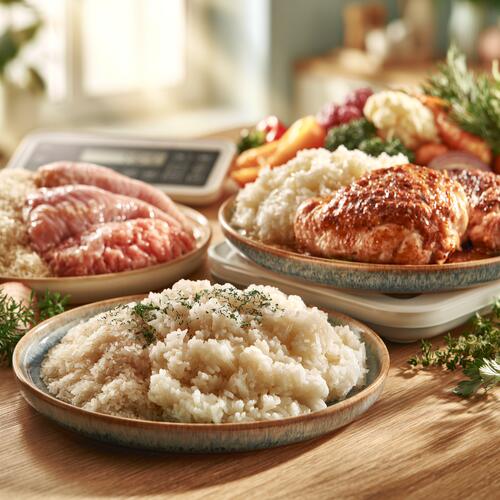 How to Count Calories After Cooking: Why the Product Weight Changes
You weighed 100 g of dry buckwheat, cooked it, and got almost 300 g of porridge. Then you put 500 g of chicken fillet in the oven, but after cooking, only 375 g remained on the scale.
In the first case, the product became heavier, in the second—lighter. This raises a logical question: does the total caloric value of the product change after cooking, and what value should you record in your food diary?
The main rule is:
Cooking changes the weight of the product, but by itself does not create additional calories.
Grains and pasta absorb water, so their mass increases. Meat, fish, and some vegetables, on the contrary, lose water and become lighter. The total caloric value of the original product remains roughly the same, unless you added oil, sauce, sugar, breading, or other ingredients, or removed some fat or nutritional liquid from the dish.
It's not so much the total calories in the whole portion that changes, but rather their concentration per 100 g.
Short Answer
To correctly determine the caloric value of a product after cooking:
-
Count the calories of the product before cooking.
-
Weigh the entire finished product.
-
Divide the total calories by the actual cooked weight.
-
Multiply the resulting number by 100.
Formula:
Calories per 100 g of cooked product = total calories of product ÷ cooked weight × 100
For example, 100 g of dry buckwheat contains 330 kcal. After boiling, you got 300 g of porridge:
330 ÷ 300 × 100 = 110 kcal per 100 g
The whole pot still contains about 330 kcal, but now these calories are distributed not over 100 g, but over 300 g of cooked buckwheat.
Why the Weight of a Product Changes After Cooking
Most of the changes are related to water.
During cooking, a product can:
-
absorb water;
-
lose water due to evaporation;
-
release juice;
-
lose some fat;
-
absorb oil or sauce;
-
increase due to other added ingredients.
That's why the same amount of dry and cooked product can't be counted using one value from a database.
USDA culinary yield tables also consider weight change as a result of moisture loss, water absorption, and changes in fat content during cooking.
Products That Usually Gain Weight
The following absorb water:
-
buckwheat;
-
rice;
-
oatmeal;
-
bulgur;
-
pearl barley;
-
pasta;
-
lentils;
-
beans and chickpeas;
-
some dried mushrooms.
The more water a product absorbs, the lower its calories per 100 g will be in the finished form.
Products That Usually Lose Weight
The following lose water:
-
chicken;
-
turkey;
-
beef;
-
pork;
-
fish;
-
mushrooms;
-
zucchini;
-
eggplants;
-
potatoes when baked;
-
other vegetables during prolonged heat treatment.
The more water the product lost, the higher will be the calories per 100 g of the cooked product.
Why Boiling Doesn’t Add Calories
Regular water contains no calories. If a grain or pasta absorbed water and became heavier, no additional calories appeared in them.
Imagine you put 100 g of dry buckwheat with 330 kcal into a pot.
After boiling, you may get:
| Cooked buckwheat weight | Total calories | Calories per 100 g |
|---|---|---|
| 250 g | 330 kcal | 132 kcal |
| 300 g | 330 kcal | 110 kcal |
| 330 g | 330 kcal | 100 kcal |
In all three cases, the total calories in the grains are the same. The only difference is the amount of water.
This is why you can find different calorie values for boiled buckwheat in various tables. One porridge was fluffier; another was more moist. There is no universal value that is guaranteed to fit every pot.
If the grain was cooked not only in water, the situation changes. Milk, cream, sugar, oil, and other additions have their own calories and must be accounted for separately.
Example Calculation for Dry and Boiled Buckwheat
Suppose the package indicates:
-
dry buckwheat: 330 kcal per 100 g;
-
weight of dry buckwheat: 200 g.
First, calculate the total calories for all dry grains:
330 × 200 ÷ 100 = 660 kcal
After cooking, you weighed the porridge and got 580 g.
Now determine the calories of the cooked buckwheat:
660 ÷ 580 × 100 = 113.8 kcal per 100 g
Round up to 114 kcal.
If you ate 180 g of this porridge:
114 × 180 ÷ 100 = 205.2 kcal
About 205 kcal should be added to your food diary.
What Happens if You Select Dry Buckwheat and Indicate the Cooked Weight
Suppose you ate 180 g of cooked buckwheat but selected dry buckwheat in the database (330 kcal per 100 g).
The app would calculate:
330 × 180 ÷ 100 = 594 kcal
The real calorie content was about 205 kcal. The error was almost 390 kcal.
The reverse error is also possible. If you weigh 100 g of dry grains and select boiled buckwheat in the database, the calories will appear much lower than they are.
For more details on choosing the right product state, see the article “Counting Calories of Foods Raw or Cooked”.
Don’t want to count manually? Add the ingredients and the actual cooked weight to SIT30. The app will automatically calculate the calories per 100 g and for each portion.
Why Cooked Meat Has More Calories per 100 g
The process is the opposite with meat. When baking, frying, or boiling, it usually loses water. The finished piece becomes lighter, so there are more protein, fat, and calories in each 100 g.
At the same time, the chicken does not become more caloric because of the oven. There is just more original meat and less water in 100 g of the cooked product.
Example Calculation for Raw and Baked Chicken
Suppose you took:
-
500 g raw chicken fillet;
-
calories per the package: 110 kcal per 100 g;
-
no oil or sauce added.
Total calories of the raw chicken:
110 × 500 ÷ 100 = 550 kcal
After baking, the fillet weighs 375 g.
Calories in cooked chicken:
550 ÷ 375 × 100 = 146.7 kcal per 100 g
Round up to 147 kcal.
If you ate 150 g of cooked chicken:
147 × 150 ÷ 100 = 220.5 kcal
So:
-
100 g of raw chicken had 110 kcal;
-
100 g of baked chicken has about 147 kcal;
-
total calories in all cooked chicken is about 550 kcal.
No additional calories were created by the oven. Part of the water simply evaporated from the meat.
Does Total Caloric Value Always Remain Unchanged?
For regular home tracking, it's convenient to assume that the caloric value of the original product is preserved. But this rule doesn't work absolutely in every situation.
Some calories might leave the product with:
-
rendered and drained fat;
-
juice left in the pan and discarded;
-
broth that was not used;
-
removed skin;
-
breading remaining in the pan;
-
other edible parts that were not included in the finished dish.
For example, if a lot of fat is rendered from fatty meat and all of it was drained, the actual calorie content of the finished meat will be lower than if you calculate with all original calories preserved.
Accurately determining how much fat or nutrients remained in the pan is difficult at home. That's why for everyday food diaries, a practical calculation by ingredients and actual finished yield is used.
For lean chicken breast, grains, pasta, or baked vegetables, this method usually gives a realistic enough result.
How Oil Changes the Calorie Content of Cooked Food
Oil should not be considered part of the weight change due to water. It contains calories itself and must be included in the calculation.
Let’s look at the previous chicken example:
-
chicken fillet 500 g: 550 kcal;
-
vegetable oil 10 g: about 90 kcal;
-
cooked chicken weight: 375 g.
Total calories:
550 + 90 = 640 kcal
Calories per 100 g:
640 ÷ 375 × 100 = 170.7 kcal
Without oil: 147 kcal per 100 g; with oil: about 171 kcal per 100 g.
The difference is significant, especially if oil is poured on the pan without weighing.
How to Account for Oil More Accurately
You can use one of these methods:
-
Place the bowl or pan on the scale, zero it out, and add the oil.
-
Weigh the oil bottle before and after cooking.
-
Include all added oil in the recipe ingredients.
-
If a significant amount of oil is clearly left in the pan, estimate and subtract the remainder.
For stable tracking, it's easier to add a moderate amount of oil and count all of it. A small possible error is usually safer than the habit of not recording oil at all.
How to Account for Sauces and Marinades
Mayonnaise, cream, sour cream, honey, sugar, teriyaki, and other sauces can significantly change the calorie content of a dish.
They should be added as separate ingredients.
For example:
-
chicken: 550 kcal;
-
oil: 90 kcal;
-
sauce: 120 kcal;
-
total calories: 760 kcal;
-
cooked weight: 430 g.
Calculation:
760 ÷ 430 × 100 = 176.7 kcal per 100 g
Meanwhile, light additives such as salt, spices, lemon juice, or a small amount of soy sauce may barely affect the result. But their impact depends on the type and amount.
Don’t rely on just the label “sauce.” Always check the nutritional information on the package.
How to Account for Breading
Breading adds calories not only from flour, breadcrumbs, or starch. It can also retain oil during frying.
To calculate, you need to account for:
-
meat or fish;
-
egg;
-
flour;
-
breadcrumbs;
-
starch;
-
cheese;
-
oil;
-
sauce;
-
other breading components.
If part of the flour or breadcrumbs stayed on the plate and wasn't used on the product, the most accurate method would be:
-
Weigh the breading before cooking.
-
After cooking, weigh the leftover breading.
-
Add only the actually used amount to the recipe.
For example, you prepared 60 g of breadcrumbs, but after breading, 25 g remained. So, about 35 g of breadcrumbs were added to the dish.
Universal Recalculation Formula
For a single product without additions:
Calories per 100 g after cooking = calories of the raw portion ÷ cooked weight × 100
To find the calories of the raw portion:
Total calories = calories per 100 g × raw weight ÷ 100
Full formula:
Calories per 100 g of the cooked product = (calories per 100 g raw product × raw weight ÷ 100) ÷ cooked weight × 100
For a dish with several ingredients:
Calories per 100 g of the finished dish = total calories of all ingredients ÷ actual cooked weight × 100
Example: Calculating a Multi-Ingredient Dish
You cooked chicken with sauce.
Ingredients:
| Ingredient | Weight | Calories |
|---|---|---|
| Chicken fillet | 600 g | 660 kcal |
| Vegetable oil | 10 g | 90 kcal |
| Natural yogurt | 100 g | 65 kcal |
| Mustard | 15 g | 20 kcal |
| Spices and salt | to taste | 0 kcal |
| Total | 835 kcal |
After cooking, the dish weighs 520 g.
Calories per 100 g:
835 ÷ 520 × 100 = 160.6 kcal
Round to 161 kcal.
If a portion weighs 180 g:
161 × 180 ÷ 100 = 289.8 kcal
You can write 290 kcal in your diary.
Why You Can’t Use a Constant Coefficient
Sometimes, people advise assuming that meat always loses 20 or 25 percent of its weight, and grains always increase exactly threefold.
These coefficients are suitable only for an approximate estimate.
The actual yield depends on:
-
amount of water;
-
cooking time;
-
temperature;
-
size of the pieces;
-
type of grains;
-
fat content of the meat;
-
presence of a lid;
-
cooking method;
-
degree of readiness;
-
and how long the dish stood after cooking.
Today, 100 g of buckwheat may turn into 280 g of porridge, tomorrow—into 330 g. Chicken fillet after a short bake will lose less water than after prolonged cooking.
Thus, the most accurate home method is not to use universal coefficients but to weigh the specific cooked dish.
Do You Need to Recalculate Each Time?
It’s not necessary to recalculate a dish each time you cook, if you use:
-
the same amount of ingredients;
-
the same cookware;
-
the same amount of water;
-
the same cooking mode;
-
roughly the same cooked yield.
You can create a recipe once and then use the saved value.
But if the yield changes significantly, it’s better to adjust the recipe. For example, last time you got 600 g of casserole; today only 480 g. Calories per 100 g will be different.
For maximum accuracy, weigh the cooked yield of every new batch. For regular weight control, it’s acceptable to update the calculation only if the recipe or cooking method changes noticeably.
What If You Forgot to Weigh the Product Before Cooking?
There are several options.
Check the Weight on the Package
If you cooked the entire package of grain, pasta, meat, or fish, use the mass indicated by the manufacturer.
Don’t forget to subtract:
-
the package;
-
bones;
-
skin, if you didn’t eat it;
-
liquid from a can;
-
inedible parts.
Use the Remaining Weight
If some raw product remains, subtract it from the original package weight.
For example:
-
the package had 800 g of chicken;
-
after cooking, 200 g of raw chicken remains;
-
you used 600 g.
Select Cooked Product from the Database
When it’s impossible to determine the original weight, find the most similar cooked product in the database:
-
boiled buckwheat;
-
boiled rice;
-
baked chicken breast;
-
fried fish;
-
baked potatoes.
This will be an approximate estimate because the exact amount of water and oil is unknown.
This entry is still better than skipping the meal completely.
How to Count Calories After Cooking in SIT30
In the SIT30 calorie counter, you can create your own recipe and specify the actual cooked yield. The app will calculate the calories per 100 g of the finished dish.
Step-by-Step Instructions
-
Open the SIT30 side menu.
-
Go to the “My Recipes” section.
-
Click the “+” sign in the lower right corner.
-
Select “Add new recipe.”
-
Enter the name of the dish, for example “Boiled Buckwheat” or “Baked Chicken Breast.”
-
Click the green “+” next to the ingredients section.
-
Add all the products in the state in which you weighed them.
-
Specify the exact weight of each ingredient.
-
Be sure to add oil, sauces, cream, cheese, sugar, and breading.
-
Cook the dish.
-
Weigh the entire cooked product without the pot, baking dish, or pan.
-
Enter the actual weight in the yield field for the finished dish.
-
Save the recipe.
SIT30 will calculate:
-
total calories;
-
the amount of protein, fat, and carbohydrates;
-
calories per 100 g;
-
nutritional value of the chosen portion.
When you add the dish to your diary, you only need to weigh your portion and indicate its weight.
Don’t want to count manually? Add the ingredients and the actual cooked weight to SIT30. The app will automatically calculate calories per 100 g and for each portion.
How to Create a Recipe for a Single Product
The “My Recipes” section can be used not only for soup, pilaf, or casseroles.
Create individual items:
-
“My Boiled Buckwheat”;
-
“My Boiled Rice”;
-
“Oven Chicken Breast”;
-
“Homemade Baked Fish”;
-
“Air Fryer Potatoes.”
The recipe can have just one main product. Add its raw weight and, after cooking, enter the cooked yield.
This way, you get the calories of your actual buckwheat or chicken, not an average value from the database.
Common Mistakes
Mistake 1. Weighing the Cooked Product but Selecting Raw
For example, entering 200 g of boiled buckwheat as 200 g of dry. The calorie count will be overestimated several times.
Mistake 2. Weighing the Raw Product but Selecting Cooked
In this case, the app will record too few calories.
Mistake 3. Not Weighing the Cooked Output
Without the actual weight, it’s impossible to accurately determine calories per 100 g.
Mistake 4. Counting Only the Main Product
Oil, cream, cheese, sugar, sauces, and breading sometimes add more calories to a dish than you think.
Mistake 5. Weighing a Dish Together with the Cookware
First, place the empty pot or baking dish on the scale and record its weight. Then weigh the dish with the food and subtract the weight of the cookware.
Even easier is to transfer the food to another container, having zeroed the scales beforehand.
Mistake 6. Dividing by Raw Weight Instead of Cooked
To calculate calories per 100 g of the cooked dish, you need to divide the total calories by the weight after cooking.
Mistake 7. Using Someone Else’s Value for a Homemade Dish
Someone else's buckwheat may have absorbed more water, and their chicken may have been cooked with oil. For an accurate count, calculate your own recipe if needed.
Simple Memo
If the product became heavier:
-
it most likely absorbed water;
-
the total calorie content hardly changed;
-
calories per 100 g decreased.
If the product became lighter:
-
it most likely lost water;
-
total calorie content changed slightly, if at all;
-
calories per 100 g increased.
If you added oil, sauce, or breading:
-
total calorie content increased;
-
all additives must be included in the recipe.
If some fat, broth, or juice was discarded:
-
some calories may have gone with it;
-
the exact calculation becomes more difficult;
-
for home tracking, a reasonable estimate is acceptable.
Key Takeaways
The calories per 100 g of a product after cooking change mainly because of the change in water quantity and final weight.
Grain absorbs water and becomes less caloric per 100 g. Meat loses water, so cooked 100 g contains more calories than raw 100 g.
To get an accurate result:
-
Weigh ingredients before cooking.
-
Calculate their total calories.
-
Include oil, sauces, and breading.
-
Weigh the finished dish.
-
Divide the total calories by the cooked weight.
-
Multiply the result by 100.
This calculation can be performed automatically in SIT30. Create your own recipe, add ingredients, enter the actual yield, and later only record the weight of the portion you eat.
FAQ
Does the total caloric value of a product change after cooking?
For everyday calculations, the total calories of the original product are usually considered unchanged, unless you added other ingredients or removed fat, broth, or other nutritious parts. The main change is due to water content and product weight.
Why is boiled buckwheat less caloric than dry?
Boiled buckwheat contains more water. The calories of the dry grains are distributed over a larger weight, so the calories per 100 g of cooked are lower.
Why is baked chicken more caloric per 100 g than raw?
When baking, chicken loses water and becomes lighter. In 100 g of the cooked product, there is more original meat, so calories per 100 g go up.
How do you calculate the calories per 100 g of a cooked product?
Divide the total calories of all ingredients used by the weight of the cooked product and multiply by 100.
Should you include water when cooking grains?
Plain water contains no calories, so there’s no need to include it in calorie calculations. But it affects cooked weight and calories per 100 g.
Should you include oil for frying?
Yes. Oil contains many calories and must be included in the recipe. For easy tracking, it’s best to count all oil added, especially if it remains in the dish or sauce.
Can you use the database value for the finished product?
You can, if you do not know the exact original weight. But it will be an approximate estimate, since the amount of water, oil, and yield may vary.
How to count homemade buckwheat or baked chicken in SIT30?
Create your own recipe, add the original product and all additional ingredients, then specify the actual post-cooking weight. SIT30 will automatically calculate calories per 100 g.