

Money Walking: What Is It and Does the New Trend Work?
 Money Walking: What Is This New Trend and Does It Really Work?
Not so long ago, people went for walks to reach 10,000 steps, lose weight, or just clear their heads. Now, walking has a new goal: financial.
On social media, "money walking" is gaining popularity. Participants set a certain financial goal, walk a set distance daily, reflect on their income, and hope that the required amount will appear in their lives during the challenge period.
Some share stories of new clients and unexpected transfers. Others are skeptical and believe coincidences prove that the practice works.
Let’s figure out what money walking is, whether you really have to walk 12 km, where the 21 days came from, and whether you can really improve your financial situation with walks.
What is Money Walking?
Money walking is a walk combined with a financial goal, visualization, and observation of your own thoughts.
In the most common version, the participant:
-
Chooses a specific amount they want to receive.
-
Writes the financial goal down on paper.
-
Decides how many kilometers and days they will walk.
-
Thinks about their goal while walking.
-
After the walk, writes down any ideas or events that came up.
-
Continues the practice daily, usually for 21 days.
On social networks, there are many variations of “Money Walking” and “Money Steps” from different authors. There is no single instruction. Some versions suggest walking 12 km daily, while others recommend walks of 20–60 minutes. Sometimes, participants repeat affirmations, sometimes they walk without a phone or music, and sometimes they simply reflect on what prevents them from earning more.
Therefore, today, money walking is more of a collective term for several practices than a strictly defined method.
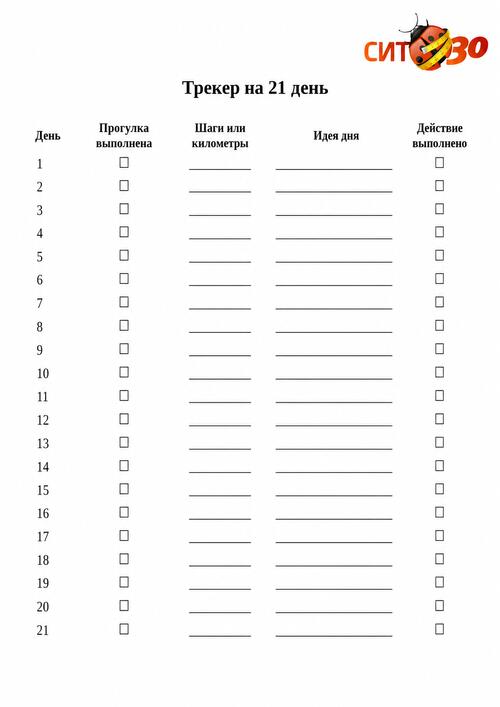

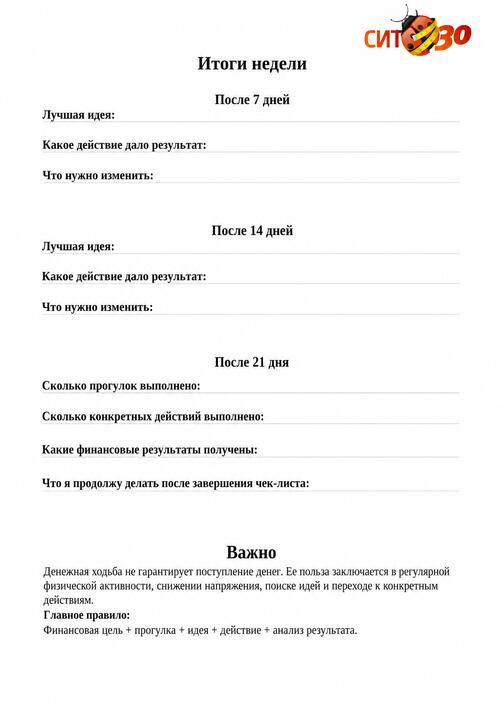
Download the “Money Walking” checklist for 21 days, print it, and mark the results of your walks.
Download the checklist in WordWhy Should You Walk Exactly 12 km?
The number 12 is often mentioned in publications about money walking. A popular scheme looks like this:
-
formulate a financial goal;
-
walk 12 km every day;
-
continue for 21 days;
-
record financial receipts and changes.
But there is no scientific or physiological rationale specifically for 12 km.
For most adults, 12 km is about 16,000–18,000 steps. The exact amount depends on height, step length, speed, and terrain. Such a walk usually takes about two or three hours.
This is already a serious daily amount of activity, especially for a person who previously walked 3,000–5,000 steps a day.
The number 12 in this case is a rule of the challenge, not a medical recommendation. To gain benefits from walking, it is not necessary to cover such a distance daily.
The World Health Organization recommends that adults get at least 150–300 minutes of moderate-intensity aerobic activity per week. Any physical activity is better than none at all.
If a person previously led a sedentary lifestyle, it is safer to start with their usual number of steps and gradually add 500–1,000 steps.
A detailed plan for gradually increasing activity can be found in the article “How to Start Walking More if You Don’t Have Time”.
Does Money Walking Actually Work?
The answer depends on what you consider as a successful result of the practice.
Can Walking by Itself Attract Money?
There is no scientific evidence that a certain number of kilometers, repeating affirmations, or visualization can directly cause money to appear.
A walk won't force an employer to give you a raise, clients to place an order, or a bank to write off a loan. Money coming after a walk does not prove that the walk was the cause.
For example, a salary, benefit, or payment from a client could have arrived on the same day regardless of participation in the challenge.
This easily leads to a thinking error: a person begins to notice only the events that confirm their expectations. Every arrival of money is attributed to the practice, while lack of results is explained by insufficient faith, an incorrectly chosen goal, or a missed walk.
Can a Walk Help Generate New Ideas?
Yes, this effect is possible.
While walking, a person temporarily moves away from their desk, notifications, and current problems. This creates space for calm reflection.
In a Stanford University study, participants performed better at generating new ideas while walking than while sitting. However, walking mainly helped with open-ended idea generation, not with tasks where there is only one correct answer.
This is where money walking can have practical meaning.
During a walk, one may come up with:
-
who to offer their services to;
-
how to improve a product;
-
what to change in advertising;
-
which expenses to cut;
-
where to find extra work;
-
how to discuss a raise;
-
which skill would increase their market value.
But money does not appear from the thought itself. It can come only after a specific action taken because of that thought.
Can Money Walking Improve Psychological Well-Being?
Regular walking can have a positive influence on mood and anxiety levels. Systematic reviews and meta-analyses show that walks can reduce symptoms of anxiety and depression, though the effect depends on personal condition, session format, and other factors.
Financial problems are often accompanied by tension. In a constant state of anxiety, a person may:
-
avoid checking their accounts;
-
postpone talks about debts;
-
be afraid to name their price;
-
make impulsive decisions;
-
fail to notice available options;
-
spend money to temporarily boost mood.
A calm walk will not solve financial problems, but may sometimes help lower emotional tension and allow for more rational actions.
Why Do Participants Feel Money Walking Works?
Feedback on such practices cannot be considered scientific proof. However, many participants do actually notice changes. Usually this is explained by several factors.
Focus on Goal Increases
Before the challenge, a wish like “I want to earn more” may remain abstract. After setting a concrete amount, attention shifts toward income-related opportunities.
A person notices job vacancies, offers, client requests, and ideas for side work more often.
Discipline Emerges
It’s not hard to walk several kilometers once. Doing it every day for several weeks is much harder.
If the participant keeps their promise to themselves, they may get a sense of control. Sometimes, this discipline carries over to other actions: calling clients, managing a budget, publishing content, or studying.
The Public Commitment Effect Occurs
Bloggers often tell their followers their goals and post daily reports. After this, giving up the challenge becomes psychologically more difficult.
Publicity pushes people to act more actively than if the goal remained only in their thoughts.
The Number of Actions Increases
The participant doesn’t just walk. They talk about their goal, shoot videos, interact with their audience, make offers, and remind others about their services.
It’s these actions that can attract new clients and income. But from the outside, it’s easy to attribute results to the walks.
Coincidences Are Perceived as Patterns
If someone gets a debt repaid, a bonus, or a long-awaited payment during the challenge, they may link these events to money walking.
At the same time, payments that came before the practice or a month after it ended are usually not considered.
How to Try Money Walking for Real Benefit
To keep the practice from turning into wishful thinking, the financial goal needs to be connected to measurable actions.
Step 1. Formulate a Specific Goal
Not “I want a lot of money”, but, for example:
“I want to increase my income by 30,000 rubles per month over three months.”
The goal should be clear and verifiable. It’s ideal to indicate the amount, time frame, and planned income source.
Step 2. Break Down the Amount into Manageable Parts
Suppose you want to earn an extra 30,000 rubles.
This amount could come from:
-
three clients with a profit of 10,000 rubles each;
-
ten sales with a profit of 3,000 rubles each;
-
fifteen extra work hours at 2,000 rubles per hour;
-
raising the price of a service;
-
reducing unnecessary spending;
-
a combination of several sources.
After such a calculation, the financial goal stops looking abstract.
Step 3. Choose a Reasonable Distance
You don’t need to start with 12 km right away.
Base it on your current activity level:
-
less than 5,000 steps per day: start with a 20–30 minute walk;
-
5,000–8,000 steps: add 2–3 km;
-
8,000–12,000 steps: you can gradually increase the distance;
-
over 12,000 steps: choose based on how you feel and your recovery.
The main goal is regularity, not hitting a randomly chosen number.
Step 4. Take One Question on Your Walk
Don’t try to repeat the amount you want for two hours straight.
It’s better to pick one practical question:
-
Where can I find my next client?
-
What prevents people from buying my product?
-
What extra service could I offer?
-
What can I do to get a raise?
-
Which expenses don’t benefit me?
-
Which skill most strongly affects my income?
-
Who should I talk to this week?
Give yourself the first 10–15 minutes just to walk. Don’t demand an immediate answer. Ideas may come closer to the end of the walk or even after you return.
Step 5. Write Down All Ideas
After the walk, write down at least three possible actions.
Don’t judge them right away. Even an obvious thought can be useful if you’ve kept putting it off before.
Step 6. Do One Action the Same Day
This is the most important rule.
For example:
-
send a proposal to a potential client;
-
update your portfolio;
-
post an announcement;
-
call your employer;
-
ask for feedback;
-
reconsider your price;
-
cancel an unnecessary subscription;
-
draw up a debt repayment plan.
Without this stage, money walking remains just a walk with dreams.
Step 7. Track More Than Just Income
In your practice journal, note the following:
-
distance walked;
-
duration of the walk;
-
the question of the day;
-
ideas that came up;
-
action taken;
-
number of proposals sent;
-
number of replies;
-
actual income;
-
expenses;
-
well-being.
This way, you’ll see whether the practice has led to a change in behavior, or if you just waited for money to come by chance.
Download the “Money Walking” checklist for 21 days, print it, and mark the results of your walks.
Download the checklist in WordAn Example of Money Walking without Esoterica
Suppose a professional wants to increase their monthly income by 40,000 rubles.
The cost of one service is 8,000 rubles. To reach the goal, five additional clients are needed.
During the walk, the person doesn't think about how the money “comes from the Universe,” but about a specific task:
“What ways can I get five new orders?”
After the walk, they write down possible options:
-
Write to former clients.
-
Ask for recommendations.
-
Prepare a new offer.
-
Publish three useful materials.
-
Launch a small advertising campaign.
-
Offer additional services to current clients.
They then choose one action and carry it out the same day.
In this case, walking really does become part of a financial strategy. But what produces results are regular actions, not the number of kilometers walked.
Can You Lose Weight with Money Walking?
The name of the practice is related to money, but for the body, it’s just regular walking.
Additional walks increase daily energy expenditure. If a person does not compensate the activity with food and maintains a calorie deficit, weight may gradually decrease.
However, 12 km per day does not guarantee weight loss. After a long walk, appetite sometimes increases, and a person may unknowingly regain the calories with a large dinner, sweet drinks, or snacks.
That’s why for weight loss, it is important to monitor not just steps but also nutrition. You can calculate daily needs and keep a food diary in the SIT30 app.
A detailed analysis of the correlation between steps and weight loss is available in the article “Walking for Weight Loss: How Many Steps a Day Do You Need?”.
Do You Have To Walk Fast?
A comfortable pace is suitable for reflection and reducing stress. You should be able to breathe easily, notice the road, and not feel like your walk is turning into a strenuous workout.
To build endurance and burn more calories, you can make part of the route faster.
A simple guide for moderate intensity:
-
you can talk;
-
singing is already difficult;
-
breathing noticeably more frequent;
-
the pace remains controlled.
You don’t need to walk all 12 km at high speed. A long distance and fast pace at the same time can be too much of a load.
For guidance on pace, see the article “Brisk Walking for Weight Loss: Speed, Heart Rate, and Intervals”.
Can You Walk with a Phone and Headphones?
A phone ban is not a strict rule.
But if the purpose of the walk is to search for ideas, constant message checking will distract you. It’s better to put your phone on silent and keep it in your pocket for at least the first 15–20 minutes.
Music and podcasts also take up attention. You can split your walk as follows:
-
first part without headphones, for thinking;
-
second part with music or an audiobook;
-
last five minutes to sum up thoughts.
At the same time, it’s advisable to keep your phone with you for communication, navigation, and safety.
Who Should Not Start with 12 km Right Away?
You shouldn’t abruptly switch to long daily walks if you previously moved very little.
Special caution is needed if you have:
-
pain in your feet, knees, hips, or back;
-
recent injury or surgery;
-
pronounced shortness of breath;
-
heart disease;
-
dizziness;
-
pregnancy with activity restrictions;
-
exacerbation of chronic diseases;
-
very high excess weight;
-
inappropriate footwear.
Start with what is manageable and increase distance gradually. If you experience chest pain, severe shortness of breath, weakness, or dizziness while walking, you need to stop.
12 km is not a minimum requirement and does not make the practice more effective.
Common Mistakes
Expecting Money Without Making Changes
A walk does not replace work, negotiations, searching for clients, learning, or financial planning.
Counting Any Income as a Result of Practice
A debt repayment or scheduled salary does not become a result of walking just because it came during the challenge.
Setting an Unrealistic Amount
Your goal should be linked to clear sources of income and actions. Wanting to receive several million in three weeks with no plan will almost certainly end in disappointment.
Starting Immediately with 12 km
A sharp increase in load may result in blisters, foot pain, and giving up on walks after just a few days.
Ignoring Nutrition
People often overestimate how many calories they burn during a walk and allow themselves to eat more. As a result, weight remains the same or increases.
Buying an Expensive Challenge Instead of Solving the Problem
A paid practice will not repay the debt or increase income automatically. Before buying, assess what specific knowledge, assignments, and support you will receive.
Be especially cautious about promises of guaranteed income or return on investment.
Money Walking: Helpful Trend or Another Esoteric Practice?
It all depends on your approach.
If a person believes that the necessary amount will appear just because they walked 12 km and repeated an affirmation, the practice differs little from other rituals for attracting money.
But if the walk is used to reduce anxiety, seek solutions, and establish discipline, it can become a useful tool.
The effective formula looks like this:
Financial goal + walk + concrete ideas + daily actions + tracking the result.
Sometimes, it really is easier to walk a few kilometers than to sit in front of a blank sheet of paper forcing yourself to come up with a solution. But after the walk, you’ll still have to write to a client, prepare a proposal, review your budget, or start learning something new.
Money doesn’t come for steps. Steps can help you get to the actions that bring money.
Frequently Asked Questions
What is money walking, simply put?
It’s a walk during which you focus on a specific financial goal, analyze obstacles, and look for ways to increase income. In popular challenges, the practice is repeated daily for several weeks.
How many kilometers should you walk?
On social media, 12 km is often mentioned, but there is no mandatory standard. Start with a distance suitable for your level of fitness. Even a 20–30 minute walk can be beneficial.
Why do people do money walking for 21 days?
This is a rule of the popular challenge. There is no evidence that any habit forms in exactly 21 days or that a financial goal is always achieved in this period.
Does money walking really attract money?
There is no evidence of a direct connection between distance walked and receiving money. The practice may help indirectly if you come up with new solutions while walking and then take specific actions.
Is it necessary to walk without a phone?
No. It’s best to take your phone for safety reasons. However, disabling notifications is recommended so they don’t interfere with your thoughts.
Can you lose weight by walking 12 km per day?
Yes, if walking helps you create a calorie deficit and you don’t compensate for the activity by eating more. The distance alone does not guarantee weight loss.
How many steps is 12 km?
For most adults, it’s roughly 16,000–18,000 steps. The exact number depends on your stride length, height, speed, and route.
Can a beginner walk 12 km right away?
Not recommended. A sudden increase in activity may cause pain, blisters, and overexertion. First, determine your usual number of steps, then increase it gradually.