

20-Minute Home Workout for Beginners: No Jumps and No Complicated Equipment
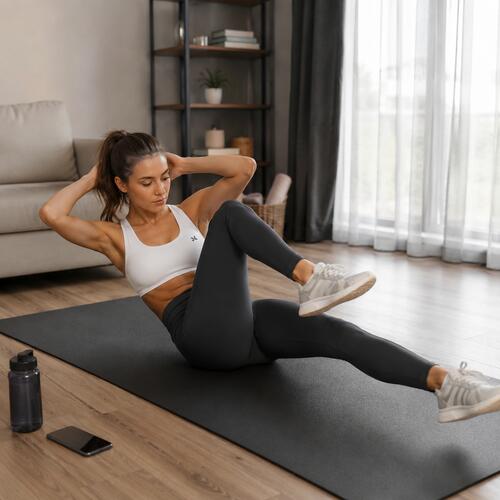 Who is this workout suitable for?
This routine is suitable if you:
-
haven’t worked out in a while and want to start gently
-
don’t like jumping, want to protect your knees and back
-
want to strengthen your body and tone up at home
-
want minimal time commitment but real results
Goal of the workout: load your whole body, improve tone and endurance, without harming your joints.
What equipment do you need?
Nothing essential.
-
mat or towel
-
chair or sofa (support for squats and push-ups)
Optional: resistance band, a pair of dumbbells or water bottles, but not required.
How to train safely
Rules for beginners:
-
Work with reserve: leave 2-3 reps in reserve, don’t go to failure
-
Technique is more important than speed
-
Light shortness of breath is normal, joint pain is not
-
Rest 30-60 seconds between sets if needed
Guideline: the workout should feel “pleasantly challenging,” but doable.
3-Minute Warm-Up
The warm-up is short, but mandatory.
-
March in place for 60 seconds
-
Arm and shoulder circles for 30 seconds
-
Hip circles for 30 seconds
-
Bent-over torso stretches with a straight back for 30 seconds
-
10 slow squats down to the chair
20-Minute At-Home Workout Without Jumps
Format: 2 rounds of 7 exercises.
Time: 40 seconds work, 20 seconds rest.
Rest between rounds: 60 seconds.
If it’s too hard, do 30 seconds work and 30 seconds rest.
Exercise 1. Chair Squat
How to do it:
-
feet shoulder-width apart
-
hips move back as if sitting down
-
knees follow the line of your toes
Modification: sit down and stand up from the chair.
Progression: slow tempo, 3 seconds down.
Exercise 2. Glute Bridge
How to do it:
-
lie on your back, feet close to your hips
-
lift your hips, squeezing your glutes
Modification: reduce range of motion.
Progression: pause for 2 seconds at the top.
Exercise 3. Push-Ups from a Raised Surface
Support: desk, couch, windowsill.
How to do it:
-
body straight, abs engaged
-
elbows angled, not flaring out
Modification: higher surface.
Progression: lower surface.
Exercise 4. Row to Waist with Towel or Band
Without a band:
-
grab a towel, press your feet against it, pull toward you, squeezing shoulder blades
With a band:
-
bent-over row of the band to waist
Modification: smaller range of motion.
Progression: pause 1-2 seconds at end of movement.
Exercise 5. Reverse Lunge with Support
How to do it:
-
step back, keep torso upright
-
hold onto the back of a chair
Modification: smaller step, less depth.
Progression: without support or go slower.
Exercise 6. Dead Bug for Core
How to do it:
-
lower back pressed to the floor
-
slowly straighten opposite arm and leg
Modification: move only legs.
Progression: go slower, more control.
Exercise 7. Plank on Knees or Against the Wall
How to do it:
-
body straight
-
don’t let your lower back sag
Modification: plank against the wall for 30-40 seconds.
Progression: classic elbow plank.
2-Minute Cool-Down
-
slow march in place for 60 seconds
-
glute and thigh stretch for 60 seconds
How many times per week should you do this workout?
Optimal for beginners:
-
3 times per week, every other day
If it’s really tough: 2 times per week, but consistently.
To lose weight faster, add walking as a daily base.
2-Week Progress Plan
Week 1
-
2 rounds, 40/20 or 30/30
-
focus: technique and consistency
Week 2
Choose one way to progress:
-
add 5 seconds of work for each exercise
or -
reduce rest by 5 seconds
or -
add a third round (if you feel good)
Don’t do everything at once. Progress should be gradual.
Common Beginner Mistakes
-
Tempo too fast and “jerky” technique
-
Working out every day without recovery
-
Lack of back training (rows are essential for posture)
-
Judging results by the scale the next day
-
Ignoring walking and a regular sleep schedule
Frequently Asked Questions
Is this workout good for weight loss?
Yes, as part of a system. Weight loss is defined by a calorie deficit, and the workout helps with energy expenditure and preserving muscle.
Can I do the workout every day?
For beginners it’s better 2-3 times a week so your body recovers. On other days, add walking.
What if my knees hurt?
Skip lunges, do chair squats and glute bridges. Watch your form, don’t go to deep angles. If pain persists, it’s best to consult a doctor or specialist.
Are dumbbells necessary?
No. At the start, your own body weight and tempo control are enough. You can add a resistance band or dumbbells later for progress.
When will I see results?
You’ll feel it gets easier after 1-2 weeks of consistent training. For visual changes, it’s best to track them in photos and measurements once every 2-4 weeks.