

How to Count Calories Without Scales: Food Table in Spoons and Cups | SIT30
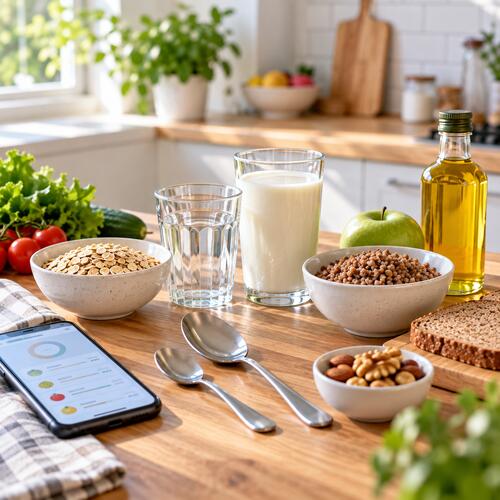 How to Count Calories Without Scales: Product Measurements Table in Spoons, Cups, and Portions
Kitchen scales are the most convenient way to count calories accurately, but they are not always at hand. When visiting friends, at work, traveling, or even at home, you may sometimes need to estimate the weight of food using spoons, cups, packaging, or portion sizes.
It is possible to count calories without scales. The accuracy will be lower, but for an ordinary food diary, this is often enough, especially if you measure your usual portions a few times in advance.
Short answer: use the known volume of spoons and cups, the product weight on the packaging, the number of identical pieces, and your usual portions. For oil, nuts, cheese, sweets, and other calorie-dense products, you should be especially attentive, as even a small mistake in grams can significantly affect the total calorie count.
How to Count Calories Without Kitchen Scales
The principle remains the same as with standard counting.
First, you need to estimate the portion weight, then check the calorie content of the product per 100 g and recalculate it for the amount eaten.
Formula:
calories in portion = calories per 100 g × portion weight ÷ 100
For example, a bread package indicates 250 kcal per 100 g. You estimate that two slices weigh 60 g.
250 × 60 ÷ 100 = 150 kcal.
There are approximately 150 kcal in two slices.
The main difficulty without scales lies precisely in determining the portion weight.
How Many Grams in a Teaspoon and a Tablespoon
It’s important not to confuse volume and weight.
A standard teaspoon holds about 5 ml of liquid, a tablespoon about 15 ml.
But 15 ml of water, oil, honey, and flour will all weigh differently because they have different densities.
Therefore, the claim “a tablespoon always holds 15 grams” is incorrect.
Table of Liquid and Thick Products
| Product | Teaspoon | Tablespoon | 200 ml |
|---|---|---|---|
| Water | about 5 g | about 15 g | about 200 g |
| Milk | about 5 g | about 15 g | about 200 g |
| Kefir | about 5 g | about 15-18 g | about 200 g |
| Vegetable oil | about 5 g | about 14-17 g | about 180-190 g |
| Natural yogurt | about 5-7 g | about 15-20 g | about 200 g |
| Sour cream | about 7-10 g | about 20-25 g | about 200-250 g |
| Honey | about 7-10 g | about 20-30 g | about 280 g |
The values are approximate. The result varies especially for thick products and when measuring a heaping spoonful.
For calorie counting, it’s best to use a level spoon if you use the table.
Table of Dry Products in Spoons
For dry products, error is usually even higher. The result depends on grain size, product moisture, and how tightly the spoon is filled.
| Product | Teaspoon, leveled | Tablespoon, leveled |
|---|---|---|
| Sugar | about 5 g | about 15-20 g |
| Salt | about 5-7 g | about 15-20 g |
| Wheat flour | about 3-5 g | about 8-15 g |
| Oat flakes | about 3-5 g | about 10-12 g |
| Dry rice | about 5-8 g | about 15-20 g |
| Dry buckwheat | about 5-8 g | about 15-20 g |
The wide range in the table is not an error. A typical household spoon is not an accurate measuring instrument.
If you regularly eat the same product, it’s much more useful to weigh your usual spoon once and remember the result.
For example, it turns out your tablespoon of oat flakes weighs 11 g. In the future, you can use 11 g instead of looking up average values online every time.
How to Measure Oil Without Scales
Oil is one of those foods where an error is especially noticeable.
One teaspoon of vegetable oil is usually about 5 g, a tablespoon about 14-17 g.
If there are about 900 kcal in 100 g of oil, even an extra 10 g adds about 90 kcal.
That’s why the phrase “just a little oil in the pan” can substantially change the calorie content of a dish.
If you don’t have scales, it's more convenient to pour oil by the teaspoon, not straight from the bottle. This way, you can at least estimate the amount.
If you're cooking one dish for the whole family, include all the added oil in the total calorie count of the meal, and then divide it among the portions.
This method is described in detail in the SIT30 article “How to Count Oil When Frying, Baking, and in Salad.”
150 g of Kefir: How Many Spoons Is That?
This question often arises when you quickly need to add a product to your diary.
A tablespoon holds about 15-18 g of kefir.
That means:
150 ÷ 15 = 10 spoons.
If the spoon is large and holds about 18 g:
150 ÷ 18 = about 8.3 spoons.
So 150 g of kefir is approximately 8-10 tablespoons.
But it’s much more convenient to use a cup. For most types of kefir, 150 g is roughly equal to 150 ml, which is about three-quarters of a 200 ml glass.
How to Measure Grains Without Scales
Here, it’s important to determine what product you are dealing with: the dry grains or already cooked porridge.
For example, 50 g of dry buckwheat may turn into about 130-170 g of cooked grains after boiling. The water changes the weight, but adds practically no calories.
Therefore, you cannot take the calorie content of dry buckwheat and multiply it by the weight of the cooked portion.
If you measured the grains dry, use the values for the dry product.
If you have already cooked buckwheat and don’t know the original weight, choose “boiled buckwheat” in your food database and estimate the volume of your portion.
This topic is discussed in detail in the article “Counting Calories Raw or Cooked: Counting Rules.”
How to Estimate a Portion of Cooked Porridge
An average serving of cooked grains as a side is often between 100-200 g.
But you can’t assume any bowl of buckwheat is 150 g.
One deep plate can hold twice as much as another. Besides, one person piles up the porridge evenly, another makes a large heap.
A practical approach: at home, put your usual portion of rice, buckwheat, or pasta on the scales once and remember how it looks in your plate.
After a few repetitions, it's much easier to estimate a similar portion at a café or when visiting friends.
How to Count Products by Package
This is one of the most accurate methods if there are no scales nearby.
Suppose a package of crispbreads weighs 100 g and contains 10 pieces of about the same size.
100 ÷ 10 = 10 g.
One crispbread weighs about 10 g.
If the package indicates 350 kcal per 100 g:
350 × 10 ÷ 100 = 35 kcal.
One crispbread contains about 35 kcal.
You can count cheese in individual slices, portioned yogurts, cookies, candies, crispbreads, bars, and other products with a known packaging weight in the same way.
How to Count Eggs, Fruits, and Products by Piece
For some foods, it is much more convenient to use the number of pieces rather than spoons.
A medium-sized egg without shell usually weighs about 45-55 g. A large apple can weigh much more than a small one, so the error for fruits is greater.
If a product often appears in your diet, you can weigh several typical examples once.
For example, three apples from the store weigh 145, 160, and 155 g. Later, a similar apple can be counted as a portion of about 150 g.
For long-term tracking, this is generally more useful than trying to determine the exact weight of every apple down to a gram.
Can You Use Your Palm to Estimate a Portion?
You can, but this is not a full-fledged calorie count, just a rough estimate of portion size.
A palm is convenient for measuring meat or fish, a fist for a side or vegetables, and a thumb for a small portion of fatty foods.
The problem is that the same volume of different products can have completely different calorie counts.
A fist of vegetables and a fist of nuts cannot be counted as the same portions.
Therefore, the palm method is best for situations where an accurate count is impossible: restaurants, cafes, holidays, or visiting friends.
How to Count Calories in Cafes and Restaurants
It's almost impossible to determine the exact calorie count of a restaurant dish without information from the establishment.
Even if you correctly estimate the amount of meat and side, the amount of oil, cream, cheese, sugar, and sauces may remain unknown.
In this situation, a reasonable estimate is more important than trying to get a number accurate to a single calorie.
Pay special attention to oil, creamy sauces, mayonnaise, cheese, nuts, breading, and sugary drinks. They can significantly raise the calorie content of a dish even in relatively small amounts.
If the restaurant publishes the nutritional value of dishes, use the data provided by the establishment.
100 g of Soup: How Much Is That in a Bowl?
For liquid soup, the density is usually close to water, so 100 g will approximately correspond to 100 ml.
However, borscht, puréed soup, thick pickle soup, and chicken broth vary in density and composition.
So there is no universal answer for all soups.
If your usual bowl holds 400 ml, then 100 ml of liquid soup will visually be about a quarter of its full volume.
But for homemade soup, it’s better to use another method: count the calories of all the ingredients in the pot, determine the weight or approximate volume of the ready dish, and then calculate the calories for your portion.
A similar principle is used for pilaf, cutlets, casseroles, salads, and other complex dishes.
Detailed instructions can be found in the SIT30 article “How to Count Calories When Cooking for the Whole Family.”
Which Foods Are Especially Dangerous to Estimate by Eye
The higher the calorie content of a product, the more a small mistake affects the daily total.
For example, an extra 100 g of cucumber will practically not affect the total daily calories. But an extra 20 g of oil, nuts, or peanut butter can noticeably affect the result.
Pay special attention to vegetable and butter, nuts, seeds, cheese, chocolate, honey, mayonnaise, nut butters, rich sauces, and dried fruits.
It is advisable to check these products on scales at least periodically.
How Accurately Can You Count Calories Without Scales
Don’t expect accuracy to 5 or 10 kcal.
Even the values on packaging and tables have an acceptable margin of error. Additionally, the sizes of spoons, cups, products, and portions vary.
Consistency is more important for weight control.
If today you count the same portion of porridge as 150 g, tomorrow as 100 g, and the day after tomorrow as 250 g, your diary becomes less informative.
But if you use the same references every day, you can observe the trend and adjust your diet if necessary.
How to Make Counting More Accurate Without Scales
The most practical way is not to permanently give up kitchen scales but to use them for calibration.
Over a few days, weigh your usual portions: a spoon of oil, a bowl of porridge, a piece of bread, a serving of meat, a glass of kefir, a handful of nuts.
Remember or record these values.
Very quickly, you’ll have your own table of typical portions. After this, daily weighing of each product is no longer necessary.
Do You Really Need to Count Everything to the Gram?
No.
Calorie counting is a tool, not a competition in mathematical accuracy.
For weight loss, overall energy deficit and consistency of your diet are more important than the difference between 148 and 152 g of buckwheat.
But there is an opposite extreme: systematically not counting oil, sauces, drinks, nuts, and small snacks, then thinking you’ve calculated the calorie content of your diet accurately.
A reasonable strategy is this: you can estimate regular low-calorie foods roughly, but count calorie-dense foods more precisely.
How to Count Calories Without Scales in SIT30
In SIT30, you can enter foods and ready dishes in your food diary, as well as save frequently used products and recipes.
If there are no kitchen scales nearby, first determine the approximate portion weight using packaging, a spoon, a cup, or your pre-measured usual portion, and then enter that amount in the diary.
For homemade food, it’s more convenient to calculate the entire recipe once and save it. The next time, you only need to estimate your portion size.
This way, counting takes much less time and gradually becomes a natural part of your eating routine.
Main Points
It’s possible to count calories without scales, but the result will always be an estimate.
Teaspoons and tablespoons are convenient for small amounts, cups for liquids and grains, packaging for portioned foods, and your previously measured usual portions for ready dishes.
The most important rule: don’t try to create an illusion of accuracy where none exists.
If you weigh familiar foods several times and remember the actual size of your portions, you'll be able to confidently estimate your food intake even without kitchen scales.
Frequently Asked Questions
How to count calories without kitchen scales?
Use packaging weight, number of identical pieces, teaspoons and tablespoons, cups, and pre-measured usual portions. The calorie content of a portion is calculated based on its approximate weight.
How many grams are in a tablespoon?
The volume of a standard tablespoon is about 15 ml, but the weight depends on the product. Water will be about 15 g, oil about 14 g, and thick honey much more.
How many grams are in a teaspoon?
The volume of a teaspoon is about 5 ml. For water, that’s about 5 g. Dry and thick products will weigh differently.
Can you lose weight by counting calories without scales?
Yes. Kitchen scales improve accuracy, but weight loss is determined by overall energy balance. It’s important to use the same method of portion assessment and track weight and body measurements.
How to count calories in a café?
Use restaurant-provided information, if available. If not, estimate the main components and separately account for the most calorie-dense ingredients: oil, cheese, sauces, nuts, breading, and sugary drinks.
What is more accurate: spoons or cups?
For liquids, both measures are quite convenient. For dry products, the margin of error can be significant, as the result depends on the product’s density and whether the spoon is heaped.
Do you need to count vegetables without scales?
With strict counting, it’s best to count everything. But an error in the amount of low-calorie vegetables will generally affect results much less than an error for oil, nuts, cheese, or sauce.
Also Read on the SIT30 Blog
- How to Count Calories Correctly: Scales, Portions, Oil, and Drinks
- Counting Calories Raw or Cooked: Counting Rules
- How to Count Calories for Complex Dishes: Soups, Pilaf, Salad, and Casserole
- How to Count Oil When Frying, Baking, and in Salad
- Calorie Content After Cooking: How to Count
- Calorie Allowance for Weight Loss: How to Calculate Using the Mifflin-St Jeor Formula