

Meal Plan for a Fasting Day: Menu and Tips to Stay on Track
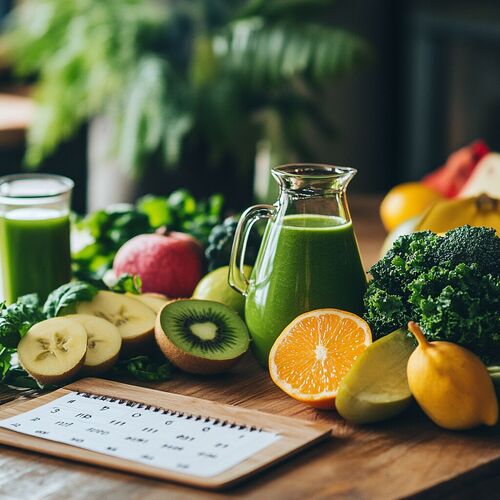 Fasting days have become a popular method for supporting health, improving well-being, and controlling weight. A properly conducted fasting day allows your body to take a break and promotes cleansing and renewal. In this article, we present specific menus with calorie breakdowns for different types of fasting days and offer tips to avoid overeating the next day.
1. Meal plans for a fasting day
When planning a fasting day, it is important to choose the option that suits you personally, taking into account your preferences, goals, and possible medical restrictions. Below are several popular options with sample menus and calorie counts.
1.1 Kefir fasting day
Essence: Consuming kefir throughout the day.
Sample menu:
-
Total volume of kefir: 1.5 liters of low-fat (1%) kefir.
-
Meal times:
- 08:00 — 250 ml kefir (~75 kcal)
- 11:00 — 250 ml kefir (~75 kcal)
- 14:00 — 250 ml kefir (~75 kcal)
- 17:00 — 250 ml kefir (~75 kcal)
- 20:00 — 250 ml kefir (~75 kcal)
- 22:00 — 250 ml kefir (optional) (~75 kcal)
Total calories: ~375–450 kcal
Additionally:
- Drink water throughout the day — at least 1.5 liters.
- Sugar-free herbal teas.
Advantages:
- Easy to digest.
- Improves gut microflora thanks to probiotics.
1.2 Vegetable fasting day
Essence: Eating raw or cooked vegetables.
Sample menu:
-
Total volume of vegetables: up to 1.5 kg (choose low-calorie vegetables).
-
Meal times:
- 08:00 — Cucumber and greens salad (200 g) with lemon juice (~30 kcal)
- 11:00 — Fresh carrot (2 pcs, 150 g) (~50 kcal)
- 14:00 — Stewed cabbage with tomatoes (300 g) (~60 kcal)
- 17:00 — Fresh cucumber (1 pc) and bell pepper (1 pc) (~30 kcal)
- 20:00 — Beetroot and carrot salad (200 g) with olive oil (1 tsp) (~70 kcal)
Total calories: ~240 kcal
Additionally:
- Water — at least 1.5 liters.
- Sugar-free herbal teas.
Advantages:
- Rich in vitamins and minerals.
- High fiber content.
1.3 Protein fasting day
Essence: Eating lean protein foods.
Sample menu:
-
Total volume of protein foods: 400–500 g
-
Meal times:
- 08:00 — Boiled chicken breast without skin (100 g) (~110 kcal)
- 11:00 — Boiled egg (1 pc) (~70 kcal)
- 14:00 — Boiled fish (cod, hake) (100 g) (~80 kcal)
- 17:00 — Low-fat cottage cheese (100 g) (~80 kcal)
- 20:00 — Steamed egg white omelet (2 egg whites) (~50 kcal)
Total calories: ~390 kcal
Additionally:
- Water — at least 2 liters.
- Unsweetened green tea.
Advantages:
- Prolonged feeling of fullness.
- Supports muscle mass.
1.4 Fruit fasting day
Essence: Consuming low-calorie fruits.
Sample menu:
-
Total volume of fruits: up to 1.5 kg
-
Meal times:
- 08:00 — Green apple (2 pcs) (~100 kcal)
- 11:00 — Pear (1 pc) (~60 kcal)
- 14:00 — Citrus salad: orange, grapefruit (200 g) (~80 kcal)
- 17:00 — Kiwi (2 pcs) (~90 kcal)
- 20:00 — Baked apple with cinnamon (1 pc) (~80 kcal)
Total calories: ~410 kcal
Additionally:
- Water — at least 1.5 liters.
- Sugar-free herbal teas.
Advantages:
- Vitamins and antioxidants.
- Improves gut function thanks to fiber.
1.5 Rice fasting day
Essence: Consuming boiled rice with no salt or oil.
Sample menu:
-
Total volume of rice: 250 g dry rice (about 600 g boiled)
-
Meal times:
- 08:00 — Boiled rice (150 g) (~180 kcal)
- 11:00 — Boiled rice (100 g) (~120 kcal)
- 14:00 — Boiled rice (150 g) (~180 kcal)
- 17:00 — Boiled rice (100 g) (~120 kcal)
- 20:00 — Boiled rice (100 g) (~120 kcal)
Total calories: ~720 kcal
Additionally:
- Water — at least 2 liters.
- Unsweetened green tea.
Advantages:
- Removes excess fluid from the body.
- Easy to digest.
Caution:
- This option is not suitable for everyone and is not recommended for digestive problems.
2. How not to overeat the next day
After a fasting day, it is important to return to a regular diet properly—not only to maintain the result but also to avoid harming your body.
2.1 Gradual return to normal nutrition
- Don't throw a "feast": Start your day with a light breakfast — porridge on water, egg white omelet, yogurt with fruit.
- Avoid heavy and fatty foods: Gradually reintroduce meat, fish, dairy products.
2.2 Frequent, small meals
- Eat 5–6 times a day in small portions to avoid hunger and overeating.
- Snack on healthy foods: nuts, fruits, yogurt.
2.3 Drink enough fluids
- Continue drinking water — it will support your metabolism and help control appetite.
2.4 Plan your meals in advance
- Make a menu for the day: This helps prevent spontaneous snacking and choosing unhealthy foods.
2.5 Listen to your body
- Eat slowly and mindfully, paying attention to signals of fullness.
- Don't eat "for company" or out of boredom.
2.6 Psychological strategies
- Reward yourself for your willpower, but not with food—consider a walk or watching your favorite movie instead.
- Avoid stressful situations that could trigger emotional eating.
2.7 Physical activity
- Add moderate physical activity: walks, yoga, light exercises help improve mood and control appetite.
A fasting day is an effective tool for maintaining health and controlling weight if approached wisely. Choose the option that suits you, take your body's features into account, and always listen to your sensations. Proper behavior after a fasting day is just as important as the fasting day itself. This will help you consolidate your results and move confidently and safely towards your goals.
Note: Before beginning fasting days, it is advisable to consult a doctor or dietitian, especially if you have chronic diseases or special health requirements.
Take care of your health, eat mindfully, and be at harmony with yourself! 😊
More articles on this topic:
"What is a fasting day and when is it appropriate?"
"Optimal frequency of fasting days: once a week or once every two weeks? An individual approach"