

Buchweizen oder Nudeln beim Abnehmen: Was hat mehr Kalorien und was ist besser
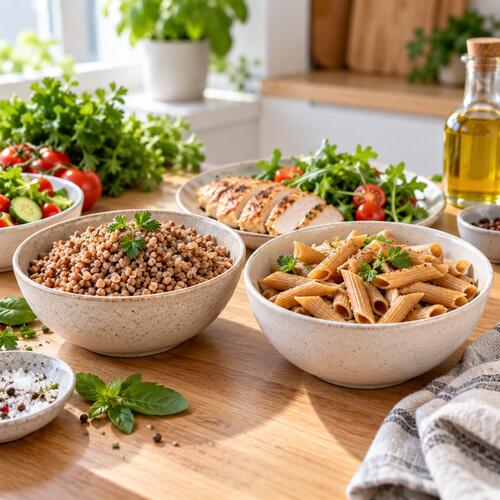 Buchweizen oder Pasta beim Abnehmen: Was ist kalorienreicher und was ist besser?
Buchweizen gilt fast als Pflichtprodukt zum Abnehmen, während viele aus Gewohnheit Nudeln zu vermeiden versuchen. Aber ist Buchweizen wirklich deutlich kalorienärmer? Kann man Pasta beim Abnehmen essen? Und was sollte man als Beilage wählen, wenn man Kalorien zählt?
Kurze Antwort: man kann sowohl mit Buchweizen als auch mit Pasta abnehmen. Im Trockenzustand ist ihr Kaloriengehalt ziemlich ähnlich. Nach dem Kochen ändern sich die Werte pro 100 g aufgrund der aufgenommenen Wassermenge. Deshalb sind nicht der Name der Beilage, sondern die Portionsgröße, die Zubereitungsart und die Gesamtkalorienbilanz entscheidend.
Schauen wir uns das genauer an.
Was ist kalorienreicher: Buchweizen oder Pasta?
Vergleicht man die trockenen Produkte, gibt es keinen großen Unterschied.
Ungefähre Werte pro 100 g Trockengewicht:
| Produkt | Kaloriengehalt |
|---|---|
| Buchweizengrütze | ca. 330-350 kcal |
| Pasta | ca. 340-370 kcal |
Die genauen Werte hängen vom Hersteller und der Zusammensetzung ab, daher sollte man für die Kalorienberechnung auf die Angaben auf der eigenen Verpackung achten.
Trockene Pasta ist also meist etwas kalorienreicher als Buchweizen, aber der Unterschied ist gering.
Völlig anders sieht der Vergleich nach dem Kochen aus.
Warum gekochter Buchweizen und Pasta pro 100 g weniger Kalorien haben
Beim Kochen nehmen sowohl Buchweizen als auch Pasta Wasser auf.
Wasser hat keine Kalorien, erhöht aber das Gewicht der fertigen Speise.
Zum Beispiel: Aus 100 g Trockenprodukt werden nach dem Kochen vielleicht schon 220, 250 oder 300 g.
Die Energiemenge steigt durch das Wasser nicht an. Die gleichen Kalorien verteilen sich nur auf ein höheres Endgewicht.
Daher ist der Wert pro 100 g des fertigen Produkts deutlich niedriger.
Ungefähr so:
| Fertiges Produkt ohne Öl und Sauce | Kaloriengehalt pro 100 g |
|---|---|
| Gekochter Buchweizen | ca. 90-120 kcal |
| Gekochte Pasta | ca. 120-160 kcal |
Dies sind ungefähre Werte. Sie hängen in erster Linie davon ab, wie viel Wasser das Produkt aufnimmt.
Deshalb kann man nicht die Packungsangaben von trockenem Buchweizen mit Kalorientabellen für gekochte Pasta vergleichen.
Wenn Sie sich fragen, welches Gewicht Sie bei Getreide und Pasta verwenden sollten, finden Sie zusätzliche Informationen in diesem Artikel: Wie berechnet man Kalorien im rohen oder gekochten Zustand.
Warum 100 g trockene und 100 g fertige Pasta nicht das Gleiche sind
Das ist einer der häufigsten Fehler beim Kalorienzählen.
Nehmen wir an, auf der Packung Pasta steht 350 kcal pro 100 g.
Sie kochen 100 g trockene Pasta, erhalten z.B. 240 g fertige Pasta.
Im ganzen Topf sind immer noch etwa 350 kcal, sofern Sie keine anderen Zutaten hinzugefügt haben.
Aber jetzt gilt:
350 ÷ 240 × 100 = ca. 146 kcal pro 100 g fertige Pasta.
Wenn Sie die gesamten 240 g essen, bekommen Sie ebenfalls etwa 350 kcal.
Pasta wird also durch das Kochen nicht doppelt so kalorienarm. Die Kalorienzahl pro 100 g ändert sich nur wegen des Wassers.
Beim Buchweizen ist es genauso.
Buchweizen oder Pasta zum Abnehmen
Wenn es speziell um Gewichtsreduktion geht, hat keine Beilage einen entscheidenden Vorteil gegenüber der anderen.
Abnehmen erfolgt, wenn man durchschnittlich weniger Energie mit der Nahrung aufnimmt, als man verbraucht.
Man kann täglich Buchweizen essen und nicht abnehmen, wenn die Gesamternährung zu kalorienreich ist.
Und umgekehrt kann man regelmäßig Pasta essen und trotzdem abnehmen, sofern ein moderates Kaloriendefizit eingehalten wird.
Deshalb sollte die Frage eher lauten:
«Was darf man beim Abnehmen essen – Buchweizen oder Pasta?»
Sondern besser so:
«Welche Portion dieses Produkts kann ich in meinen Speiseplan aufnehmen?»
Warum Buchweizen so oft zum Abnehmen empfohlen wird
Buchweizen hat tatsächlich einige praktische Eigenschaften.
Er ist einfach zuzubereiten, passt gut zu Fleisch, Fisch, Eiern und Gemüse und die Portion lässt sich leicht kontrollieren.
Außerdem enthält Buchweizen Ballaststoffe und gibt eine recht sättigende Beilage.
Das bedeutet aber nicht, dass er eine besondere Fähigkeit besitzt, Fett zu verbrennen.
Gibt man einer großen Portion Buchweizen viel Butter, eine fettreiche Sauce und kalorienreiches Fleisch hinzu, kann das Gericht deutlich kalorienreicher sein als eine normale Portion Pasta mit Gemüse und Hähnchen.
Darf man Pasta beim Abnehmen essen?
Ja.
Allein die Tatsache, dass Pasta im Speiseplan enthalten ist, steht einer Gewichtsabnahme nicht entgegen.
Wichtiger sind:
-
Die Portionsgröße.
-
Der Gesamtkaloriengehalt des Gerichts.
-
Die Menge an Öl und Saucen.
-
Andere Lebensmittel über den Tag hinweg.
-
Die Zusammensetzung der Pasta.
Wenn Sie Pasta mögen, gibt es keinen Grund, sie allein deshalb vollständig auszuschließen, weil Sie abnehmen möchten.
Das Verbot von Lieblingsspeisen erschwert es oft sogar, die Ernährung langfristig einzuhalten.
Welche Pasta sollte man wählen?
Am einfachsten: auf die Zutaten achten.
Bei normalen, hochwertigen Nudeln ist die Zutatenliste meist kurz.
Wenn Sie den Ballaststoffanteil erhöhen möchten, können Sie zu Vollkornpasta greifen.
Allerdings sollte man nicht denken, dass die Aufschrift «aus Hartweizen» die Portion praktisch kalorienfrei macht.
Auch solche Pasta enthält Kalorien.
Der Unterschied liegt eher in der Zusammensetzung und den Produkteigenschaften, nicht in der „Verschwinden“ der Energie.
Vollkornpasta oder Buchweizen?
Hier wird der Vergleich noch interessanter.
Vollkornpasta enthält in der Regel mehr Ballaststoffe als normale Pasta aus raffinierter Mehl.
Die Aussage «Buchweizen ist immer gesünder als jede Pasta» ist daher zu simpel.
Beide Produkte können Teil einer normalen, ausgewogenen Ernährung sein.
Die Wahl kann sich richten nach:
-
Geschmack;
-
Verträglichkeit;
-
der Zusammensetzung des jeweiligen Produkts;
-
Ballaststoffgehalt im gesamten Speiseplan;
-
womit Sie die Beilage kombinieren möchten.
Es ist nicht notwendig, täglich dieselbe Kohlenhydratquelle zu wählen.
Was sättigt mehr: Buchweizen oder Pasta?
Das Sättigungsgefühl hängt nicht nur von der Beilage ab.
Eine wichtige Rolle spielt die gesamte Mahlzeit.
Zum Beispiel sättigen 150 g Buchweizen pur oft weniger als 150 g Pasta mit Hähnchenbrust, Gemüse und Salat.
Und umgekehrt.
Um eine Mahlzeit sättigender zu machen, ist es sinnvoll, die Beilage mit einer Proteinquelle und Gemüse zu kombinieren.
Zum Beispiel:
-
Buchweizen + Hähnchen + Gemüse;
-
Pasta + Fisch + Gemüse;
-
Buchweizen + Ei + Salat;
-
Pasta + Pute + Gemüsesauce.
Das Sättigungsgefühl wird nicht nur von der Beilage beeinflusst. Sehen Sie auch: Wie viel Eiweiß braucht man beim Abnehmen und wie verteilt man es auf die Mahlzeiten?
Fertige Kombinationen aus Beilage, Protein und Gemüse finden Sie in der Sammlung 15 sättigende Mittagessen für die Gewichtsabnahme bei 300, 400 und 500 kcal.
Was ist nach dem Training besser?
Sowohl Buchweizen als auch Pasta können als Kohlenhydratquelle nach dem Training verwendet werden.
Es besteht keine Notwendigkeit, ausschließlich Buchweizen zu essen.
Wenn die Ernährung ausreichend Eiweiß enthält und die Gesamtkalorienbilanz Ihrem Ziel entspricht, passt auch normale Pasta in die Mahlzeit nach körperlicher Aktivität.
Zum Beispiel:
-
Pasta + Hähnchen + Gemüse;
-
Buchweizen + Fisch + Salat;
-
Pasta + Pute + Tomatensauce.
Das Wichtigste ist, dass die gesamte Tagesernährung den Bedürfnissen des Körpers entspricht.
Was ist besser zum Abendessen: Buchweizen oder Pasta?
Beide Produkte können verwendet werden.
Allein die Tageszeit macht weder Pasta noch Buchweizen zu Fett.
Für die Gewichtsabnahme ist die gesamte Energiebilanz wichtiger.
Wenn es Ihnen abends passt, eine kleine Portion Pasta mit Protein und Gemüse zu essen, müssen Sie diese nicht durch Buchweizen ersetzen nur wegen der Uhrzeit.
Das Gleiche gilt für Buchweizen.
Das Problem liegt meist nicht an der spezifischen Beilage, sondern an der Gesamtportion am Abend und weiteren Lebensmitteln.
Zum Beispiel haben 150 g Pasta für sich genommen und ein großer Teller Pasta mit Cremesauce, Käse und Öl völlig unterschiedliche Kalorienwerte.
Wenn die größte Schwierigkeit abends auftritt, schauen Sie hier: Was abends essen, um ohne Hunger abzunehmen.
Wie viel Buchweizen kann man beim Abnehmen essen?
Es gibt keine universelle Portion für alle.
Die Menge hängt von der Gesamtkalorienzufuhr, Körpergewicht, Aktivität und den übrigen Mahlzeiten ab.
Für viele Menschen kann eine Portion von etwa 100-200 g gekochtem Buchweizen als Ausgangspunkt dienen.
Aber das ist keine strenge Norm.
Für die einen sind 100 g passend, für andere 200 g oder mehr.
Wichtig ist, genau die Portion zu berücksichtigen, die Sie tatsächlich gegessen haben.
Wie viel Pasta darf ich beim Abnehmen essen?
Das Prinzip ist dasselbe.
Eine typische Portion gekochter Pasta liegt meist bei ca. 100-200 g, aber es gibt keinen universellen Wert.
Wenn Sie Kalorien zählen, ist es am praktischsten, die trockene Menge vor dem Kochen zu bestimmen.
Zum Beispiel nehmen Sie 60 g trockene Pasta.
Wenn die Packung 350 kcal pro 100 g angibt:
350 × 60 ÷ 100 = 210 kcal.
Nach dem Kochen werden daraus vielleicht 140-170 g fertige Pasta, aber der Energiewert bleibt etwa gleich.
Was verhindert Abnehmen schneller: Pasta oder die Zusätze dazu?
Sehr häufig liegt das Problem gar nicht an der Pasta.
Betrachten wir einen Beispiel-Teller:
-
Pasta 200 g;
-
Cremesauce;
-
Käse;
-
ein Esslöffel Öl;
-
Hackfleisch.
Die Beilage selbst macht oft nur einen Teil des gesamten Kaloriengehalts aus.
Öl, Käse und fettreiche Saucen können das Endergebnis deutlich erhöhen.
Deshalb denken viele, dass «man von Pasta dick wird», obwohl ein erheblicher Teil der Kalorien durch die Zusätze kommt.
Bei Buchweizen ist es genauso.
Buchweizen mit Butter, gebratenem Fleisch und einer fetten Sauce ist auch kein „leichtes“ Gericht mehr.
Öl ist besonders wichtig. Wir haben separat erklärt, wie man Öl beim Braten, Backen und im Salat berechnet.
Buchweizen mit Öl oder Pasta ohne Öl: Was ist kalorienreicher?
Das Ergebnis kann hier durchaus überraschen.
Pflanzen- und Butter haben eine sehr hohe Energiedichte.
Daher kann eine Portion Buchweizen mit viel Öl mehr Kalorien enthalten als eine gleich schwere Portion Pasta ohne Öl.
Deshalb ist es beim Kalorienzählen wichtig, nicht nur das Hauptprodukt zu berücksichtigen.
Oft werden gerade folgende Produkte vergessen:
-
Bratöl;
-
Butter;
-
Käse;
-
Mayonnaise;
-
Saucen;
-
Sahne;
-
Nüsse und Samen.
Oft erklären gerade diese Zusätze die Differenz zwischen angenommener und realer Kalorienzahl eines Gerichts.
Was ist gesünder: Buchweizen oder Pasta?
Man kann Lebensmittel nicht nur auf Basis des Namens in absolut gesund oder ungesund einteilen.
Buchweizen bringt seine Nährstoffkombination mit.
Pasta aus Weizen hat eine andere Zusammensetzung.
Vollkornpasta unterscheidet sich von normaler Pasta.
Darüber hinaus ernährt sich niemand nur von einer Beilage.
Für die Gesundheit ist die Vielfalt der Gesamternährung wichtiger: Gemüse, Obst, Eiweißquellen, Vollkornprodukte, ausreichend Ballaststoffe und ein vernünftiger Fettanteil.
Sie müssen also keinen Sieger küren und nur diesen essen.
Darf man Buchweizen und Pasta abwechseln?
Ja, für die meisten Menschen ist das viel praktikabler, als jeden Tag nur Buchweizen zu essen.
Beispiel:
-
Montag – Buchweizen;
-
Dienstag – Pasta;
-
Mittwoch – Reis;
-
Donnerstag – Kartoffeln;
-
Freitag – wieder Buchweizen.
Ein abwechslungsreicher Speiseplan lässt sich meist über längere Zeit leichter einhalten.
Abnehmen sollte nicht zur endlosen Schale trockenen Buchweizens und Hähnchenbrust werden.
Buchweizen oder Pasta: Vergleich
| Parameter | Buchweizen | Pasta |
|---|---|---|
| Kaloriengehalt (trocken) | ca. 330-350 kcal | ca. 340-370 kcal |
| Geeignet beim Abnehmen | Ja | Ja |
| Am Abend erlaubt | Ja | Ja |
| Als Beilage geeignet | Ja | Ja |
| Kaloriengehalt hängt stark von Zusätzen ab | Ja | Ja |
| Vollkorn-Optionen vorhanden | nicht relevant | Ja |
| Beim Abnehmen zu meiden | Nein | Nein |
Den Hauptunterschied beim Abnehmen machen meist nicht die 10-20 kcal zwischen den Produkten, sondern die Portionsgröße und was sonst noch auf dem Teller landet.
Wie berechnet man Kalorien von Buchweizen und Pasta richtig?
Die praktischste Methode:
-
Trockenes Produkt abwiegen.
-
Kaloriengehalt auf der Verpackung ablesen.
-
Kalorienzahl der eigenen Trockenportion berechnen.
-
Nach dem Kochen die fertige Menge auf die gewünschten Portionen aufteilen.
Beispiel: Sie kochen 200 g trockene Pasta.
Auf der Verpackung steht 350 kcal pro 100 g.
200 g = 700 kcal.
Nach dem Kochen ergeben sich 500 g Pasta.
Also:
700 ÷ 500 × 100 = 140 kcal pro 100 g fertiges Produkt.
Jetzt können Sie die fertige Portion abwiegen.
Mit Buchweizen ist das Prinzip identisch.
Wenn Sie gerade erst anfangen, ein Ernährungstagebuch zu führen, hilft die Anleitung: Wie man Kalorien, Portionen, Öl und Getränke richtig berechnet.
Was tun, wenn das Gewicht steht?
Pasta gegen Buchweizen auszutauschen, nur weil das Gewicht stagniert, reicht meistens nicht aus.
Überprüfen Sie zuerst den gesamten Speiseplan.
Das Gewicht kann zeitweise wegen Wassereinlagerungen, Verdauung, Training oder normalen physiologischen Schwankungen stehen bleiben.
Wenn die Tendenz wirklich über längere Zeit stagniert, lohnt es sich zu prüfen:
-
Portionsgrößen;
-
Öl;
-
Getränke;
-
Snacks;
-
Saucen;
-
Wochenenden;
-
Genauigkeit der Berechnung.
Oft sind einige kleine Kalorienquellen ausschlaggebender als die Wahl zwischen Buchweizen und Pasta.
Häufige Fragen
Was ist kalorienreicher: Buchweizen oder Pasta?
Im Trockenzustand ist der Kaloriengehalt ziemlich ähnlich. Pasta ist oft etwas kalorienreicher, aber der Unterschied ist gering. Nach dem Kochen hängen die Werte stark vom aufgenommenen Wasser ab.
Darf man Pasta beim Abnehmen essen?
Ja. Wenn die Portionsgröße in Ihre tägliche Kalorienbilanz passt, steht Pasta dem Abnehmen nicht im Weg.
Was ist besser zum Abnehmen: Buchweizen oder Pasta?
Beide Produkte sind geeignet. Die Wahl hängt von Ihren Vorlieben, dem Speiseplan und der Portionsgröße ab.
Darf man Pasta aus Hartweizen beim Abnehmen essen?
Ja. Aber selbst solche Pasta enthält Kalorien, daher ist die Portionsgröße entscheidend.
Darf man abends beim Abnehmen Pasta essen?
Ja. Die gesamte Kalorienbilanz des Tages ist wichtiger als das Verbot eines bestimmten Lebensmittels nach einer bestimmten Uhrzeit.
Was sättigt mehr: Buchweizen oder Pasta?
Das hängt von Portion und gesamtem Gericht ab. Protein- und Gemüsezugaben haben oft größeren Einfluss auf das Sättigungsgefühl als der Austausch einer Beilage durch die andere.
Wie viel gekochte Pasta ist beim Abnehmen erlaubt?
Es gibt keinen festen Wert. Oft werden Portionsgrößen von 100–200 g genommen, die genaue Menge hängt aber von der individuellen Kalorienbilanz ab.
Wie viel Buchweizen ist beim Abnehmen erlaubt?
Auch hier gibt es keine universelle Norm. Wichtiger ist, die Portion in die tägliche Kalorienbilanz einzurechnen.
Das Wichtigste
Buchweizen ist kein Pflichtprodukt zum Abnehmen und Pasta ist nicht verboten.
Kalorienmäßig sind trockene Produkte sehr ähnlich.
Nach dem Kochen unterscheiden sich die Werte pro 100 g vor allem durch die Wassermenge.
Wenn Sie abnehmen wollen, ist Folgendes deutlich wichtiger:
-
Portionsgröße;
-
Gesamtkalorienbilanz;
-
Menge an Öl und Saucen;
-
ausreichende Mengen an Protein und Gemüse;
-
Regelmäßiges Essen, das Sie dauerhaft einhalten können.
Man muss sich also nicht endgültig zwischen Buchweizen und Pasta entscheiden.
Essen Sie die Beilage, die Ihnen schmeckt – achten Sie auf die Menge und behalten Sie den Speiseplan insgesamt im Blick.
Dieser Ansatz ist im Alltag praktischer als eine strenge Liste «erlaubter» und «verbietener» Produkte.
 Warum man sich nach dem Essen nicht wiegen sollte und wann man wieder auf die Waage steigen kann
 Wie man Kalorien ohne Waage zählt: Produktemess-Tabelle in Löffeln, Gläsern und Portionen
 Welche Lebensmittel für eine Woche zum Abnehmen kaufen: fertige Einkaufsliste
 Welchen Joghurt soll man wählen: Die Zutatenliste lesen, nicht die Aufschrift auf der Verpackung
 Protein-Snacks: 20 Varianten aus Alltagsprodukten
 Hilft Fitness beim Abnehmen: Wie Training das Gewicht und die Figur beeinflusst
 Menü für 1600 kcal pro Tag: Fertiger Speiseplan mit Grammangaben und Nährwerten
 Warum man sogar mit gesunder Nahrung zu viel essen kann
 Wie man Kalorien zählt, wenn man für die ganze Familie kocht