How much protein is needed for weight loss: daily requirement and distribution across meals
 How Much Protein Do You Need When Losing Weight and How to Distribute It Across Meals
Protein in weight loss serves two main functions: it helps you maintain a calorie deficit more easily (satiety) and reduces the risk of muscle loss, which usually causes reduced tone and slower energy expenditure. The practical goal is to consume enough protein per day and distribute it so that each meal contains a working portion.
Why Protein Is Important During Weight Loss
-
Satiety and Appetite Control
Diets with a higher proportion of protein usually increase satiety and make it easier to stick to a deficit. -
Preservation of Muscle Mass
During a deficit, weight is lost not only from fat. Sufficient protein combined with strength training increases the chance of preserving muscle mass. -
Greater Energy Expenditure for Digestion
Protein has a higher thermic effect of food compared to fats and carbohydrates, so a diet with adequate protein is a bit easier to fit into a weight loss plan.
Protein Norms for Weight Loss: How Many Grams Per Day
Minimum for Health and How It Differs from Weight Loss Norms
For adults, the basic recommendations are about 0.8-0.83 g of protein per 1 kg of body weight per day. This is the level to meet basic needs, but it is often insufficient if you're losing weight and want to preserve muscle.
Practical Range for Weight Loss
Most data on weight loss converge on the range of:
1.2-1.6 g of protein per 1 kg of body weight per day as a working norm for more stable weight loss and better preservation of lean mass.
When Does It Make Sense to Go Higher
If you train (especially strength training), are losing weight at a noticeable deficit, and it’s important to preserve as much muscle as possible, the range is often moved upward:
-
1.6-2.2 g/kg/day as a practical guideline for those who train
-
in certain cases for well-trained individuals on a strict deficit, recommendations are even higher (calculated per body weight), to maintain muscle mass
How to Calculate Properly: Which Weight to Use
If you don’t have pronounced obesity: count from your current weight.
If you are significantly overweight: to avoid overestimating protein needs, it’s more convenient to calculate from your target weight or “realistically closest” weight (for example, minus 10-15% from current), and then adjust based on progress and satiety.
Important: Accuracy to the gram is not required. You need a range that you can realistically stick to 80-90% of days.
SYPB 30 Calorie Counter will help you calculate your protein norm in just a couple of minutes. Simply enter your data into your profile in the app.
How to Distribute Protein Across Meals
The key idea: it's better not to “eat all your protein in the evening,” but to give your body a moderate portion of protein 3-4 times a day.
Guideline for Portion Size
-
Reviews on protein distribution often use a target of about 0.4 g/kg of protein per meal (and at least 4 meals to reach 1.6 g/kg/day).
-
In practical terms, this often matches 25-30 g of protein per meal as a “working threshold” for stimulating muscle protein metabolism in most adults.
Why Distribution Is Important
More even protein distribution throughout the day can yield better results for muscle synthesis than the “little during the day, lots in the evening” method.
Ready-Made Distribution Schemes
3 Meals a Day
Suitable for those who don’t like snacks.
-
Breakfast: 30-40 g protein
-
Lunch: 35-45 g
-
Dinner: 35-45 g
4 Meals a Day (The Most Convenient Option)
-
Breakfast: 25-35 g
-
Lunch: 25-35 g
-
Dinner: 25-35 g
-
Snack: 15-30 g
Example Distribution for 112 g Protein (Weight 70 kg, 1.6 g/kg)
-
Breakfast 30 g
-
Lunch 30 g
-
Dinner 30 g
-
Snack 22 g
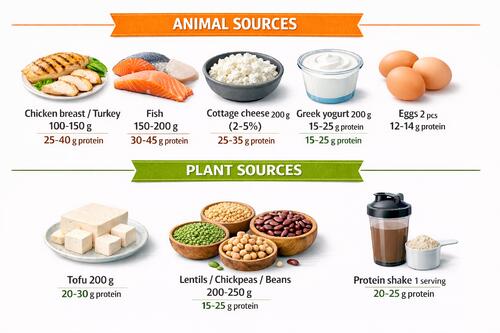 Which Foods Actually Provide Protein: Cheat Sheet
Below are approximate guidelines (depending on brand and fat content):
Animal Sources
-
Chicken breast, turkey (cooked) 100-150 g: usually 25-40 g protein
-
Fish 150-200 g: usually 30-45 g
-
Cottage cheese 2-5% 200 g: usually 25-35 g
-
Greek yogurt 200 g: about 15-25 g
-
Eggs 2 pcs: about 12-14 g
Plant Sources
-
Tofu 200 g: usually 20-30 g
-
Lentils/chickpeas/beans (cooked) 200-250 g: about 15-25 g
-
Protein powder (whey/plant-based) 1 serving: usually 20-25 g
Practical tip: if you are “falling short” on protein, it’s easiest to boost breakfast and snack (cottage cheese, yogurt, protein powder, eggs, fish) rather than trying to cram it all into dinner.
How to Top Up Protein Without Overdoing Calories
-
Choose leaner options: poultry, low-fat fish, 2-5% cottage cheese, unsweetened yogurt.
-
Cook in a way that doesn’t add extra fat: baking, stewing, grilling, nonstick skillet.
-
Watch oils, nuts, and cheese: they contain protein, but calories add up fast.
-
If it’s difficult with food, add 1 protein snack: yogurt/cottage cheese or a serving of protein powder.
Common Mistakes That Make Protein “Ineffective”
-
Protein only at dinner, almost none in the morning
Result: stronger hunger during the day, overeating in the evening. And worse distribution. -
Too little protein during a deficit
This usually increases hunger and the risk of muscle loss. -
Meeting protein needs with fatty foods and exceeding deficit
Solution: control portions of cheese, nuts, fatty meats, and oils. -
Ignoring kidney health with existing problems
If you have kidney disease or restrictions from your doctor, self-prescribing a high-protein diet is not suitable.
What to Do If Weight Stalls and You’re Counting Everything
Check these two points:
-
Actual deficit (errors in counting oil, drinks, portions) (sit30.net)
-
Why weight is stalling (sit30.net)
Also Read on the Blog
-
About choosing a calorie deficit and why “too little” often gets in the way (sit30.net)
-
5 protein salads for dinner for weight loss (sit30.net)
-
Why weight stalls during a calorie deficit: reasons and what to do (sit30.net)
FAQ
1) How much protein does a woman need for weight loss?
Usually 1.2-1.6 g/kg/day, closer to the upper boundary if you work out or have strong hunger.
2) Can you calculate protein needs based on “ideal” weight?
Yes, if you are significantly overweight, calculating from your target or intermediate target weight is often more convenient and realistic.
3) How much protein should be in one meal?
Practical guideline: 25-35 g, or about 0.4 g/kg per meal.
4) Is it necessary to eat 4 times a day?
No. But 3-4 meals a day make it easier to distribute protein evenly.
5) Are protein shakes suitable for weight loss?
They are suitable as a tool for meeting protein goals if you maintain a deficit and your overall diet is balanced.
6) Can you eat a lot of protein without harm?
For healthy people, a moderately increased protein intake is usually considered acceptable, but for kidney diseases and certain conditions, restrictions and medical supervision are necessary.