Calorie Norm for Weight Loss: How to Calculate Using the Mifflin-St Jeor Formula, Examples, and Mistakes
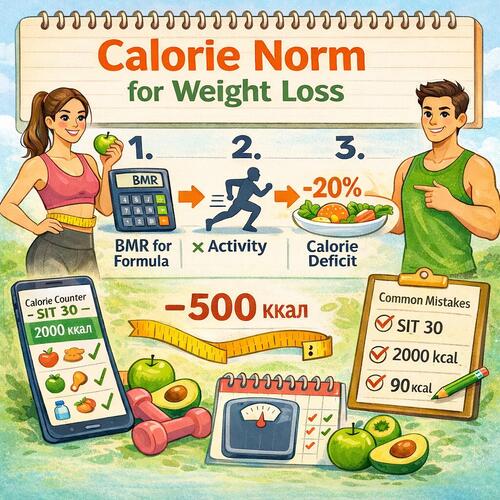 Calorie Norm for Weight Loss: How to Calculate (Formula, Example, Common Mistakes)
The right calorie norm for weight loss doesn't start with guessing and not with "1200 for everyone," but with calculating your daily needs and setting a reasonable deficit. The most practical option for most people in everyday life:
-
calculate your basal metabolic rate (BMR) using the Mifflin-St Jeor formula
-
multiply by the activity factor to get your maintenance (TDEE)
-
make a 10-20% deficit and monitor the trend for 2-3 weeks
If you don't want to count manually, the SYPB 30 calorie counter will calculate your norm automatically: just enter age, height, weight, and activity level, and you will get a guideline for maintenance and weight loss calories.
Step 1. Calculating Basal Metabolic Rate (BMR) by Formula
Mifflin-St Jeor formula:
Women: BMR = 10*weight(kg) + 6.25*height(cm) - 5*age(years) - 161
Men: BMR = 10*weight(kg) + 6.25*height(cm) - 5*age(years) + 5
BMR is the energy your body spends at rest. For weight loss, BMR is not used directly as your "nutrition norm"; you first need to move on to TDEE.
Practical tip: If you use an app, the SYPB 30 calorie counter will calculate BMR and your final calorie norm automatically, and you just need to keep records and monitor the trend.
Step 2. Get Your Maintenance Calories (TDEE)
To move from BMR to real "maintenance calories" use the activity factor:
-
Sedentary (office, few steps): BMR * 1.2
-
Light activity (1-3 workouts per week): BMR * 1.375
-
Moderate activity (3-5 workouts): BMR * 1.55
-
High activity (6-7 workouts): BMR * 1.725
-
Very high (hard physical work plus sports): BMR * 1.9
The resulting number is called TDEE. This is the calorie estimate at which your weight will, on average, stay the same (if you look at the weekly average).
If you’re unsure which factor to choose, it's easier to start with a more conservative level. In SYPB 30, activity selection is usually intuitive, and the SYPB 30 calorie counter will calculate your norm automatically taking this parameter into account.
Step 3. Creating a Deficit for Weight Loss
For most people, it’s safer to start with a moderate deficit:
-
minus 10-20% from TDEE
Important: the higher your starting weight and expenditure, the easier it is to tolerate a percentage deficit. The lower the TDEE, the more carefully you need to approach it so as not to go too low in calories.
It's convenient when the deficit is set automatically. In SYPB 30, the calorie counter itself will suggest a target calorie intake for weight loss, and if your weight changes, your norm can be quickly recalculated.
Calculation Examples: Woman and Man
Example 1. Woman
Given: 35 years old, 82 kg, 168 cm.
-
BMR = 1082 + 6.25168 - 5*35 - 161 = 820 + 1050 - 175 - 161 = 1534 kcal
-
Moderate activity (1.55)
TDEE = 1534 * 1.55 = 2378 kcal (rounded to 2380) -
Deficit 15%
Norm for weight loss = 2380 * 0.85 = 2023 kcal (rounded to 2000-2050)
Total: starting norm 2000-2050 kcal per day.
If you log your nutrition in the app, you don’t need to make this calculation manually: the SYPB 30 calorie counter will calculate your norm automatically and show your daily target calories.
Example 2. Man
Given: 42 years old, 96 kg, 182 cm.
-
BMR = 1096 + 6.25182 - 5*42 + 5 = 960 + 1137.5 - 210 + 5 = 1892.5 kcal (rounded to 1890)
-
Light activity (1.375)
TDEE = 1890 * 1.375 = 2599 kcal (rounded to 2600) -
Deficit 500 kcal
Norm for weight loss = 2600 - 500 = 2100 kcal
Total: starting norm about 2100 kcal.
How to Know If Your Norm Is Chosen Correctly
One calorie number is not “magical.” The check is always practical.
Control rules:
-
Weigh yourself 3-7 times a week in the morning, check the weekly average.
-
Keep the same nutrition tracking for at least 14 days.
-
Assess the trend, not “today’s” weight.
Guidelines:
-
If the weekly average change is about minus 0.3-0.8% of body weight per week, you are usually in the working range.
-
If your weight stays the same for 2-3 weeks in a row, lower your norm by 100-200 kcal or add more steps.
-
If you feel sudden weakness, constant hunger, poor sleep, or frequent breakdowns, the deficit is probably too aggressive.
To make things easier, track your goal and progress in one place: in SYPB 30 you see your daily norm, calories consumed, and weight trend. At the same time, the SYPB 30 calorie counter will calculate your norm automatically and it can be adjusted as needed.
Common Mistakes When Calculating Calories for Weight Loss
Mistake 1. Confusing BMR and Daily Norm
BMR is the minimum, resting expenditure. The norm for weight loss is usually calculated from TDEE, not BMR.
Mistake 2. Overestimating the Activity Factor
A common story: "I work out 3 times a week" and set too high a factor, although the rest of the time there are few steps. The result: an overestimated norm and no progress.
Mistake 3. Not Tracking Oils, Sauces, Drinks, Snacks
Oil, nuts, sweet coffee, juice, "a couple of cookies" often eat up your deficit.
Mistake 4. Relying on Workout Expenditure from Wearables
Gadgets can be inaccurate, plus people often "compensate" for workouts with food or being less active. It’s better to focus on nutrition and average weekly activity.
Mistake 5. Confusing Raw and Cooked Product Weight
Grains and meats change weight due to water. Choose one weighing standard and stick to it.
Mistake 6. Making Too Large a Deficit
Too strict restrictions are harder to maintain and increase the risk of overeating. Start moderately and adjust as needed.
Mistake 7. Lack of Structure in Nutrition
Insufficient protein and irregular meals increase hunger and the risk of slip-ups.
Mini Checklist: How to Calculate Calories in 5 Minutes
-
Calculate BMR using Mifflin
-
Select an activity factor 1.2 / 1.375 / 1.55
-
TDEE = BMR * factor
-
Starting deficit: minus 10-20% or minus 300-600 kcal
-
14 days of tracking and averaging your weigh-ins
-
Adjust by 100-200 kcal if needed
If you want it done without any formulas at all, the SYPB 30 calorie counter will calculate your norm automatically and immediately give you a target calorie value for weight loss.
Questions and Answers
What calorie deficit is the most effective?
The one you can sustain for a long time. Most often, a 10-20% reduction from maintenance or a moderate drop of 300-600 kcal works, with adjustments based on your trend.
Is it possible to lose weight without exercise, just with a deficit?
Yes. The deficit determines weight loss, while activity helps keep the result and maintain your health.
Why is my weight stuck even though I’m “in deficit”?
The reason is usually undercounting (oils, sauces, snacks), overestimated activity, water fluctuations, infrequent weigh-ins or overeating on weekends.
Do I need to recalculate calories after losing weight?
Yes. As your weight drops, your expenditure falls, and your old norm may become maintenance. Recalculate every 3-5 kg or once every 4-6 weeks. What’s convenient is that SYPB 30 will recalculate your target quickly: the SYPB 30 calorie counter will calculate your norm automatically after you update your weight.